Why does ChatGPT recommend our competitors and not us?
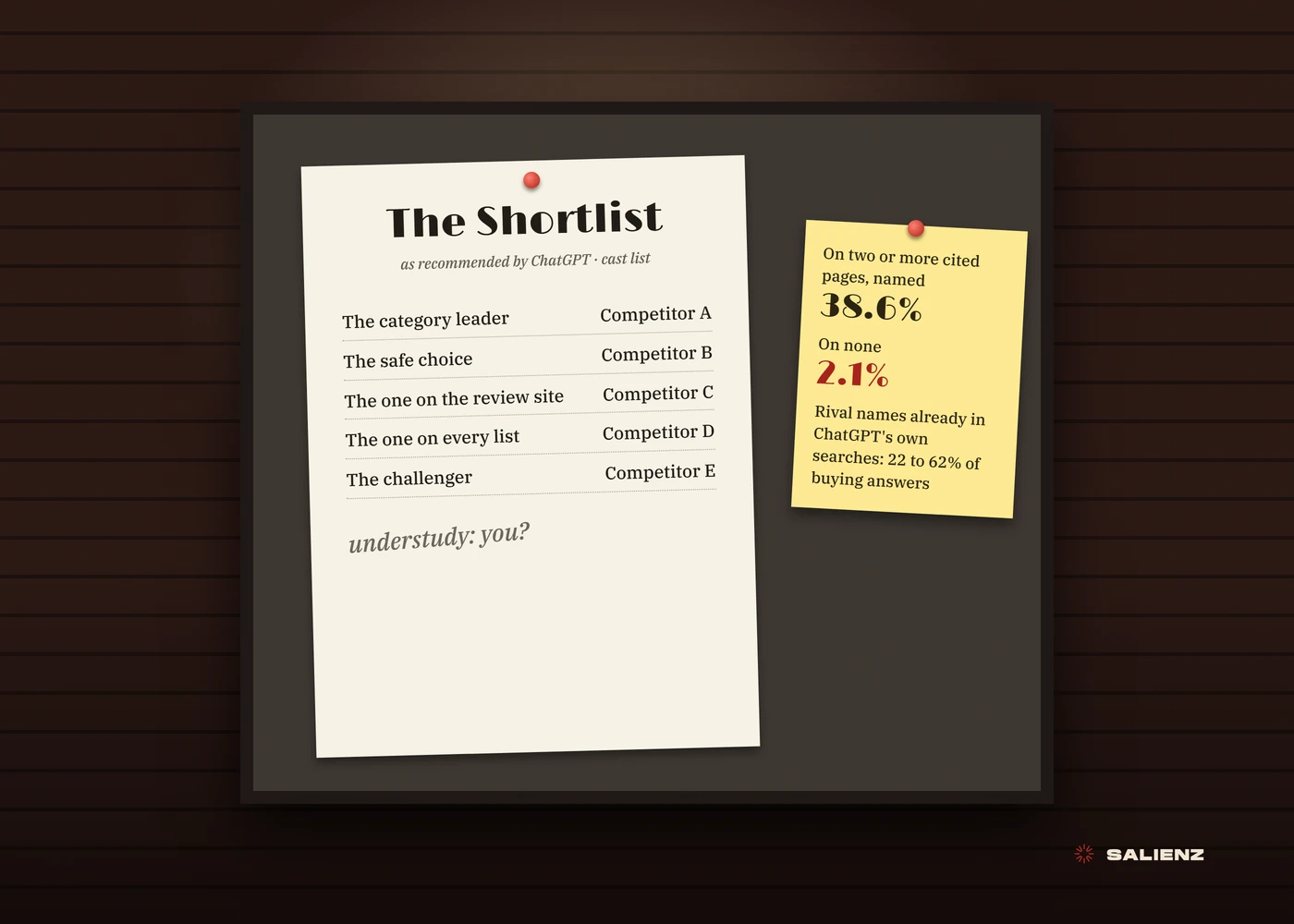
Usually for two reasons: ChatGPT already associates their names with your category, and the pages it cites mention them and not you. In three of four software markets we tracked in October 2026, ChatGPT's own searches already contained company names in 22 to 62 percent of its answers to buying questions. And a company on two or more cited pages was named 38.6 percent of the time, against 2.1 percent on none. 1 2
Does ChatGPT already know your competitors' names?
In established categories, often. When ChatGPT answers a shortlist question it runs web searches, and those searches sometimes include company names before it has read a single result. We counted it twice from 603 ChatGPT answers to buying questions: the share whose searches already named companies was 22, 45 and 62 percent in three software markets. In the youngest market, AI visibility agencies, it was 2 percent. 1
That gap is useful. In a mature category ChatGPT starts from names it already associates with the work, and a newer vendor has to appear on the pages it reads to be added. In a young category, the pages it finds decide almost everything, which is why the shortlist can move quickly there.
Are your competitors on the pages ChatGPT cites?
This weighs more, and you can change it. In our study of 18,656 answers across seven assistants, a company that appeared on none of an answer's cited pages was named 2.1 percent of the time. On one cited third-party page it was named 19.5 percent of the time, and on two or more, 38.6 percent. Competitors that are on review sites, comparison articles and best-of lists your buyers' questions return will be named more. 2
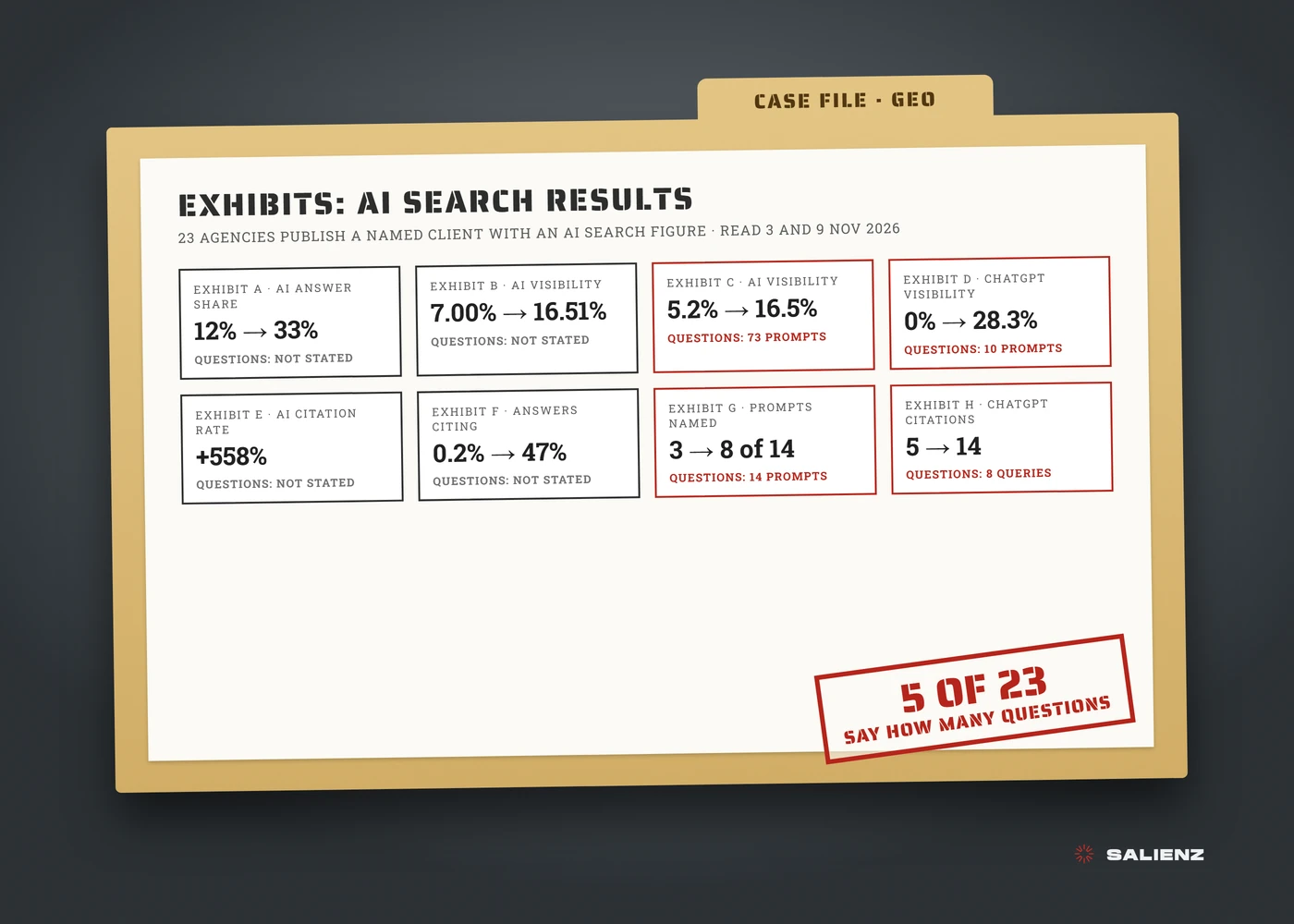
ChatGPT also looks for proof. On 8 and 9 November 2026, asked which AI visibility agencies to hire, it searched for case studies in 35 of its 44 answers. A rival that publishes named results gives it something to cite; one that does not gives it nothing. 4
Can ChatGPT read your site at all?
Check this first, because it is the quickest fix. OpenAI says sites opted out of its OAI-SearchBot crawler will not be shown in ChatGPT search answers. A robots.txt rule, a firewall or a CDN bot filter can block it without anyone deciding to. GPTBot, the training crawler, is a separate setting, so blocking training does not have to block search. 3
We rank on page one of Google. Why are we invisible in ChatGPT?
Because ChatGPT does not simply copy Google's top results. It runs its own searches, often several per question, reads the pages those return, and names the companies those pages mention. A strong ranking for your own product page helps less than you would expect if the pages ChatGPT reads are comparison articles and lists on other sites. Google's own AI Overviews draw on its index, so a page-one ranking does more there. 5 2
Answers also vary from one run to the next. In our tracking, a company named once was named again in the next run only about one time in three on Perplexity and about three times in five on Copilot and Claude. One test proves little in either direction. Ask the same questions several times before deciding you are absent. 2
What should you fix first?
- 01Make sure OAI-SearchBot can reach your site, through robots.txt, the firewall and the CDN. 3
- 02Ask ChatGPT your buyers' shortlist questions several times, and record which pages it cites and which companies it names.
- 03Get onto the cited third-party pages that leave you out: lists, reviews and comparisons. Two or more makes a large difference. 2
- 04Publish a page that answers the exact question with your company as the answer, with prices and proof a reader can check.
- 05Publish named results. ChatGPT searches for case studies when it compares vendors. 4
- 06Measure the same questions every month, so you can tell a real change from run-to-run noise.
Where does Salienz fit?
This is the diagnosis our audit is built for. The $800 Foundation audit runs 100 buyer questions on five engines, checks whether the engines' crawlers reach your pages, maps every source they cite for your category, and ends with a 90-day plan. Start with the free audit to see whether ChatGPT leaves you out. 6
Related: how to get into the listicles AI assistants cite, the agencies with a ChatGPT page, and why ChatGPT traffic goes missing from GA4.
Questions buyers ask
Receipts
06 sources- 01Salienz, ChatGPT's searches in four tracked software markets, October 2026Counted twice on 9 November 2026 from 603 ChatGPT answers to commercial, unbranded questions tracked in early October 2026: answers whose own searches already contained a company name from that market's top 25 were 22, 45 and 62 percent in three software markets and 2 percent among AI visibility agencies, 29 percent overall.Last checked 9 November 2026
- 02Salienz, How can B2B SaaS companies improve visibility in AI search results?Across 18,656 tracked AI answers in four software markets in October 2026, a company on none of an answer's cited pages was named 2.1 percent of the time, on one cited third-party page 19.5 percent, on two or more 38.6 percent; a company named in one run was named again in the next about one time in three on Perplexity and about three in five on Copilot and Claude.Last checked 8 November 2026
- 03OpenAI, Overview of OpenAI crawlersOAI-SearchBot surfaces websites in ChatGPT's search features; sites opted out of it will not be shown in ChatGPT search answers. GPTBot is the training crawler and is set separately.Last checked 9 November 2026
- 04Salienz, tracked answers, 8 and 9 November 2026Our own tracking of 22 shortlist and industry questions about AI visibility agencies. ChatGPT ran a search containing "case study" in 35 of its 44 answers.Last checked 9 November 2026
- 05Google Search Central, AI features and your websitePage last updated 10 December 2025, read 9 November 2026. No additional requirements or special optimisation for AI Overviews or AI Mode; no special schema.org markup; both may use a query fan-out technique; their traffic is counted in Search Console's Performance report.Last checked 9 November 2026
- 06Salienz, Foundation audit$800 one time: 100 prompts across five engines, a per-engine playbook, a citation source audit and a 90-day roadmap with a forecast, in 10 business days. Credited against month one if you move to a retainer within 60 days.Last checked 9 November 2026