How can a B2B SaaS company improve its visibility in AI search?
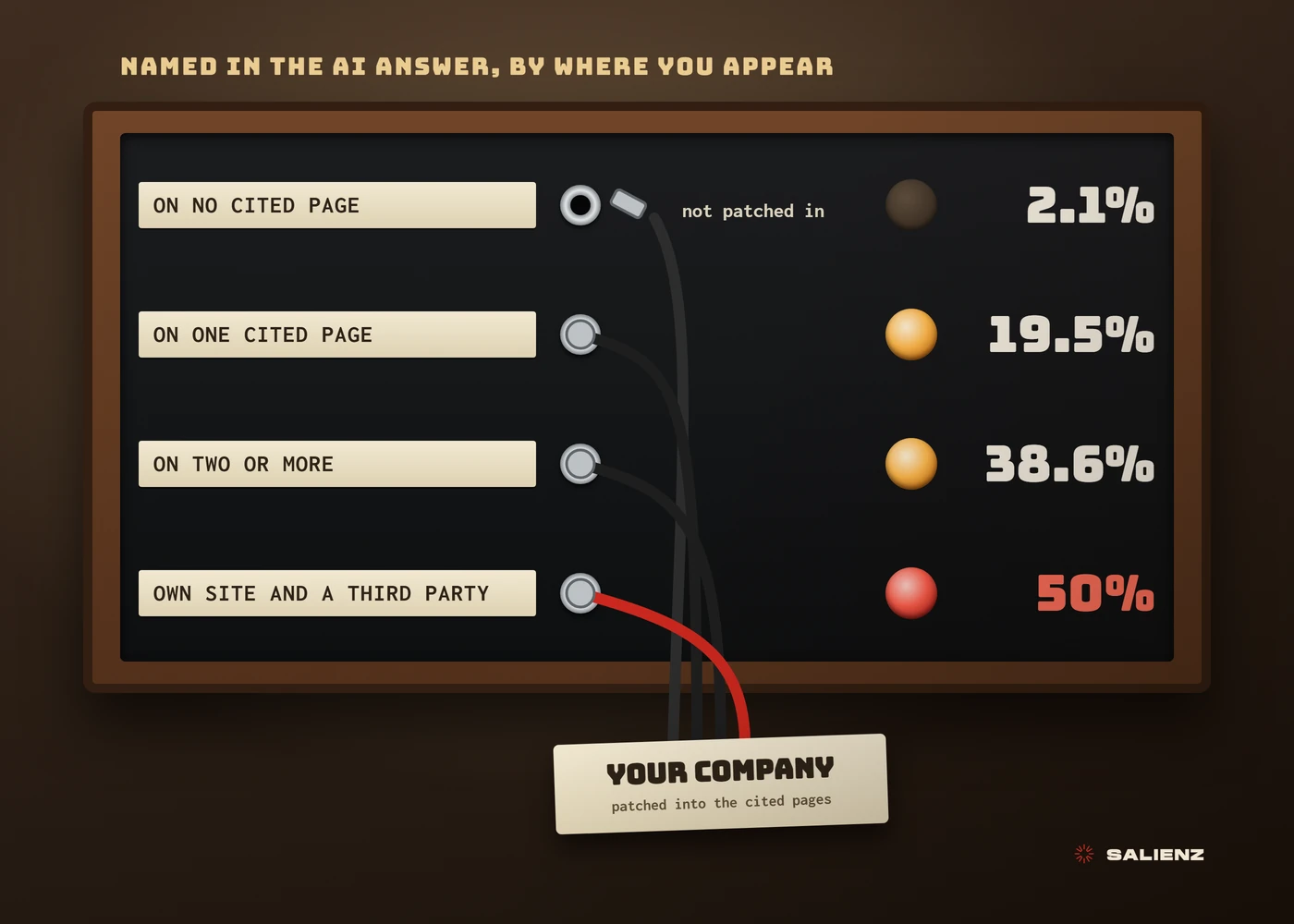
Get onto the pages AI assistants already cite when your buyers ask for a shortlist, then publish one page that answers that exact question with your company as the answer. In our study, a company on none of an answer's cited pages was named 2.1 percent of the time. On two or more third-party pages it was named 38.6 percent of the time, and with its own site cited as well, 50 percent. 1
AI search visibility is how often ChatGPT, Perplexity, Gemini, Copilot, Claude and Google's AI features name or cite your company when someone asks them a question your buyers ask. For software, the questions that matter most are the ones that end in a shortlist.
Why does this matter for B2B SaaS now?
Because the shortlist is increasingly built in a chat window. In G2's March 2026 survey of 1,076 B2B software buyers, 51 percent said they start research with an AI chatbot more often than with Google, up from 29 percent a year earlier. 69 percent said a chatbot led them to a different vendor than they expected. G2 sells review data, so read it as a strong signal from an interested party. 3
What decides whether an AI assistant names you?
Mostly, whether the pages it reads already name you. We fetched the 1,758 pages cited in our tracked answers and checked which companies each one mentions. The share of answers naming a company rose with every cited page that mentioned it. The pattern held for companies outside each market's top ten, and big brands that appeared on no cited page were named only 4.2 percent of the time. 1
| Where the company appeared | Named in the answer |
|---|---|
| On none of the cited pages | 2.1% |
| On one cited third-party page | 19.5% |
| On two or more cited third-party pages | 38.6% |
| Its own site cited | 38.3% |
| Its own site and a third-party page cited | 50% |
We checked it a second way in November, on a fresh random sample of buying-intent answers with every cited page fetched again. That check counted every company on each market's list, most of which no answer would name, so the levels came out lower. The order held: named 0.2 percent of the time on no cited page, 6.6 percent on one third-party page, 25.8 percent on two or more, and 66.2 percent with its own site and a third-party page. 2
Step 1: Find the pages AI already cites for your buyers' questions
List the ten to twenty questions a buyer asks before a shortlist, run them in each assistant several times, and record every page cited. Do it per assistant, because they read different pages. Across our data, the cited sites of any two assistants answering the same question overlapped by only about 5 to 20 percent, highest among Google's own products. 1
Rank the pages by how often they are cited and how high in the answer, and mark which ones mention you and which mention your competitors. Our guide to how a B2B SaaS company gets onto the sources Perplexity cites shows the same step for one assistant.
Step 2: Get onto two or more of those pages
One page helps, but the jump came with the second. Start with the pages cited near the top of answers. When the best-placed third-party page mentioning a company sat in the first three citations, the company was named 36.8 percent of the time; further down, 13.1 percent. 1
- Ask the editors of comparison and best-of pages to correct or update an entry, with facts they can check.
- Offer an expert section or original data they can cite. A study of your own category gives editors a reason to link to you.
- Where a page sells placements, buy only disclosed ones.
- Recheck the list every month. Cited pages change, and a page that drops out of answers stops helping.
Step 3: Publish the page that answers the exact question
Your own site helps most when the page states the answer to the buyer's question. Being cited is not the same as being named: in our AI Security Shortlist Study, one company's website was cited in 199 answers while its name appeared in 9. Most cited pages explain a subject, and the answer borrows a sentence without recommending anyone. 6
So write the page a buyer's question deserves: who the product is for, what it costs, how it compares, and which integrations and certifications it has, with the claim near the top in plain words. Pages for comparisons, alternatives and your exact use cases tend to match the questions assistants are asked on the way to a shortlist.
Step 4: Make it easy for assistants to check you
ChatGPT checks candidates before it recommends them. In our data it ran searches restricted to a candidate company's own website, looking for things like pricing or an integration, and a company it searched for by name was named most of the time. A missing pricing, integration or compliance page is a check you fail. 1
- Allow the search crawlers in robots.txt: OAI-SearchBot for ChatGPT search, Bingbot for Copilot, PerplexityBot, and Claude's search crawler. OpenAI says sites that block OAI-SearchBot will not be shown in ChatGPT search answers. 5
- For Google's AI Overviews and AI Mode, a page needs only to be indexed and eligible for a snippet. Google says there are no extra technical requirements. 4
- Put prices, integrations, certifications and the segments you serve on crawlable pages, not in PDFs or behind a form.
Step 5: Treat each assistant as its own channel
The assistants behave differently enough to plan for separately. Copilot builds shortlists from Bing's results, so dated comparison pages indexed in Bing matter there, and IndexNow gets new pages seen faster. Google's AI Overviews and AI Mode cited forums, social posts and video far more often than ChatGPT did. Claude rarely cited pages in our data, so it is the hardest to move directly. 1
Our guide to how cybersecurity companies get recommended by AI models shows how much the sources differ by assistant in one market.
How do you know it is working?
Measure how often you are named across many runs, not your position in one answer. Answers change from run to run: a company Perplexity named in one run was named again in the next only about one time in three, against about three in five on Copilot and Claude, so a single screenshot proves very little. 1
- Track a fixed set of buyer questions, re-run on a schedule, and report the share of runs that name you for each assistant.
- Count mentions of your name and citations of your site as two separate numbers.
- Track the page layer too: how many of the most-cited pages for each question mention you. It should move before the answers do.
- Expect little in analytics. Assistants send few clicks, which is why GA4 shows almost no ChatGPT traffic even when buyers name it on calls.
Where Salienz fits
This is the work Salienz does for B2B SaaS companies, in the order above. The free AI visibility audit runs 15 of your buyers' questions across five assistants and shows which pages they cite. The paid audit covers 100 questions for $800, and what an AEO budget should be at your ARR sets out what the work costs. 7
Common questions
Receipts
07 sources- 01Salienz, how AI engines decide who to name (study)18,656 answers from ChatGPT, Microsoft Copilot, Perplexity, Google AI Overviews, Google AI Mode, Gemini and Claude, tracked for Salienz in four software markets from 2 to 9 October 2026, 14,493 of them to questions naming no company. 1,758 cited pages were fetched on 17 October to see which companies each mentions. Association, not a controlled experiment. Answer totals, engine overlap and run-to-run churn were recomputed from the raw answer logs on 8 November 2026.Last checked 8 November 2026
- 02Salienz, page test replicationA fresh random sample of commercial-intent answers from the same four markets, every cited page fetched again on 8 November 2026 with robots rules respected, answers with under 60 percent of their pages fetched dropped. 22515 company and answer pairs. Every company on each market's list was counted, a broader set than the original study's, so levels are lower. Named on no cited page 0.2 percent, on one third-party page 6.6 percent, on two or more 25.8 percent, own site and a third-party page 66.2 percent.Last checked 8 November 2026
- 03G2, The Answer Economy: How AI Search Is Rewiring B2B Software BuyingSurvey of 1,076 B2B software buyers and decision-makers, March 2026, published 15 April 2026. 51 percent start software research with an AI chatbot more often than with Google, up from 29 percent in 2025; 69 percent chose a different vendor than they expected because of AI chatbot guidance. G2 sells review data, so it has an interest in the subject. Read on its report page and in its press release.Last checked 8 November 2026
- 04Google Search Central, AI features and your websiteTo appear as a supporting link in AI Overviews or AI Mode a page must be indexed and eligible to be shown with a snippet, with no additional technical requirements; both features may run several related searches, which Google calls query fan-out. Last updated 10 December 2025.Last checked 8 November 2026
- 05OpenAI, overview of OpenAI crawlersOAI-SearchBot surfaces websites in ChatGPT's search features; sites opted out of it will not be shown in ChatGPT search answers. GPTBot is the separate crawler for model training.Last checked 8 November 2026
- 06Salienz, the AI Security Shortlist Study7,385 answers from seven AI assistants to 155 cybersecurity buyer questions, October 2026. Source of the company whose website was cited in 199 answers and named in 9.Last checked 18 October 2026
- 07Salienz pricing and free auditThe free audit of 15 buyer questions across five assistants, the $800 audit of 100 questions, and retainers from $5,499 a month.Last checked 8 November 2026