The complaint arrives in a consistent shape. Sales are hearing the name on calls, sometimes in the first two minutes, and the buyer describes a shortlist an assistant handed them. Marketing opens GA4, filters for anything resembling ChatGPT, and finds a number small enough to round to zero. Somebody then concludes the tracking is broken, and spends a quarter trying to repair a measurement that is working correctly.
What is the short answer?
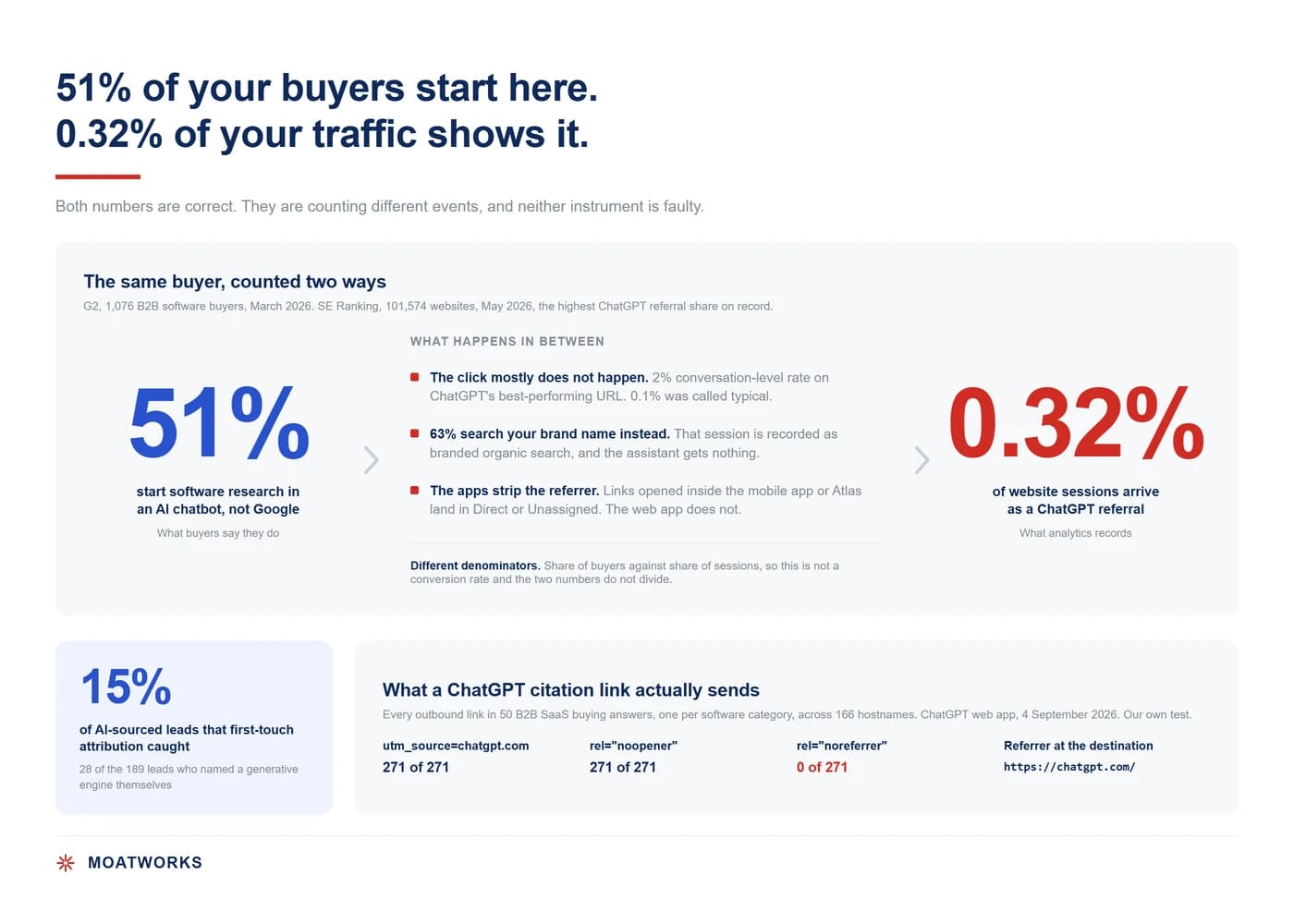
Both numbers are right. They count different events. GA4 counts clicks that reached your server carrying an identifiable source, and ChatGPT referrals were 0.32 percent of traffic across 101,574 websites in May 2026, the highest share in seventeen months of tracking. 1 Sales are hearing about a recommendation, and 51 percent of B2B software buyers now start research in an AI chatbot. 2
The influence is real and it is large. It mostly does not arrive as a click. Once that is accepted the work stops being an attribution repair job and becomes a measurement design problem, which is a different and far more tractable thing.
How big is the gap, in numbers?
Setting the two sides beside each other is worth doing once, because the ratio between them is what makes people assume a bug. The first rows are what buyers report doing. The last row is what analytics records. Neither instrument is faulty.
| What was measured | Figure | Sample and date |
|---|---|---|
| B2B software buyers who start research in an AI chatbot more often than Google | 51% | 1,076 buyers, March 2026 |
| B2B professionals who regularly use AI to research products or vendors | 66% | 622 professionals, March to April 2026 |
| Buyers saying AI has shaped their vendor shortlist | 92% | 622 professionals, March to April 2026 |
| Buyers who chose a different vendor than planned after AI guidance | 69% | 1,076 buyers, March 2026 |
| Share of website traffic arriving as a ChatGPT referral | 0.32% | 101,574 websites, May 2026 |
A useful way to hold this is that the assistant is doing the job a category listicle and three peer conversations used to do. None of those ever appeared in GA4 either. What changed is that the whole of that stage now happens inside one product your analytics can see the edge of, which makes the absence feel like a failure rather than a normal condition.
Is ChatGPT stripping the referrer?
This is the most repeated explanation and, for the web app, it is wrong. We checked rather than assumed. On 4 September 2026 we put 50 B2B SaaS buying questions through ChatGPT in a desktop browser, one software category each, read the link markup out of every rendered answer, then clicked through and read what the destination received.
| Property of the outbound link | Result across 271 links |
|---|---|
| Carried utm_source=chatgpt.com | 271 of 271 |
| Carried rel=noopener | 271 of 271 |
| Carried rel=noreferrer, which would suppress the referrer | 0 of 271 |
| Referrer received at the destination on click | https://chatgpt.com/ |
Two things follow. The referrer is sent, trimmed to the origin so the conversation URL never leaks, which is enough for any analytics package to attribute the session. And OpenAI tags every link with a campaign parameter, so even a visitor arriving with no referrer at all stays identifiable from the query string, as long as your site does not discard it on redirect. 4
One more thing is visible while the data is open, and it needs stating in the right unit. 215 of the 271 links, or 79 percent, pointed at a domain belonging to a product the answer was recommending, and 28 of the 50 answers linked to nothing else. That counts anchors rendered inside an answer, which is not the same measurement as counting citations across a corpus, so it does not compare with the published studies of what engines cite. Read narrowly it says one useful thing. A recommended vendor is not short of links. The gap opens after the link already exists. 4
Referrer loss is a genuine problem in the places we did not test. Links opened inside the mobile apps and inside Atlas arrive with the referrer removed, which drops the session into Direct or Unassigned rather than an AI channel. 5 So the honest version of the claim is narrower than the one in circulation. Some ChatGPT traffic is invisible, the web app's is not, and neither fact explains a number as small as 0.32 percent.
So where does the demand actually go?
Into two places a referral report was never going to see. The first is that the click does not happen. A confidential OpenAI report shown to a publisher put the best-performing URL at 185,000 conversation impressions against 3,800 click events, a 2 percent rate, with 0.1 percent described as typical across the wider set. 6
Ahrefs measured the same effect from the receiving end and put it plainly: visitors from AI search click links 75 percent less than they do in traditional organic search. 7 An agency tracking its own citations found its most-retrieved page appeared in AI answers 210 times and drew 10 referral sessions. 8
The second place is your own branded search line. When an assistant names a vendor, clicking the citation is not the main thing buyers do next. 3
- 71 percent go to the vendor's website, by whatever route. 3
- 63 percent search Google for the company by name, which arrives in GA4 as organic search. 3
- 46 percent compare it against alternatives. 3
- 38 percent check the G2 profile. 3
- 14 percent ask a colleague, which leaves no trace anywhere. 3
That second line is the whole gap in one number. A buyer who reads your name in an answer and then types it into Google is recorded as branded organic, and the assistant that created the demand is credited with nothing. The traffic is not missing. It is filed under the wrong cause.
Does GA4's AI Assistant channel fix this?
Partly, and it is worth turning on first because it costs nothing. Google added an AI Assistant channel to the default channel group in May 2026. When the referrer matches a recognised assistant, GA4 sets the medium to ai-assistant and the campaign to (ai-assistant) with no configuration on your side. The documentation names five: ChatGPT, Gemini, Deepseek, Copilot and Grok. 9
It also states what it excludes, and the exclusion matters more than the feature. Google's own AI surfaces are deliberately kept out, so AI Overviews and AI Mode continue to count as organic search. 9 The channel applies going forward only, so nothing from before it launched is reclassified.
| How the visit reached you | Recorded as | Channel |
|---|---|---|
| ChatGPT web app in a desktop browser | chatgpt.com / ai-assistant | AI Assistant |
| ChatGPT link opened inside the mobile app or Atlas | chatgpt.com with no medium, or no referrer at all | Unassigned, or Direct |
| Google AI Overviews or AI Mode | google / organic | Organic Search |
| Perplexity, which is not on Google's list | perplexity.ai / referral | Referral |
| Buyer who read the answer, then searched your brand name | google / organic | Organic Search |
Four of those five rows are the same buyer having the same experience, and one of them is counted as an assistant. A custom channel group built on source rather than medium collapses the first four back into a single line, which is worth an afternoon. It does nothing for the fifth, and the fifth is the largest. 5
What measurement actually closes the gap?
Asking the buyer. It is unglamorous and it is the only instrument positioned to see what your logs cannot. One agency ran the comparison on its own pipeline between 6 July and 5 August 2026. Of 213 leads who answered a free-text question about how they heard of the company, 189 named a generative engine. First-touch attribution credited 28 of those to AI. 8
The other 161 were filed as organic search, direct, or referral. Every one of those labels is defensible on the evidence the tool had. None of them is what happened. That ratio answers the question this page is about: the channel report was not undercounting by a little, it was seeing roughly one lead in seven.
What should a B2B SaaS company instrument, in order?
- 01Put a required free-text question on every demo request and contact form asking how the buyer first heard of you, and read the answers rather than counting them. This is the highest-yield single change, and in the one published comparison it recovered close to seven times what first-touch caught. 8
- 02Ask the same question on discovery calls and write the answer into a CRM field rather than into call notes, so it can be counted later. Sales already hold this information and are already saying it out loud.
- 03Build a custom GA4 channel group keyed on source rather than medium, so ChatGPT sessions fragmented across AI Assistant, Referral, Unassigned and Direct collapse into one line. 5
- 04Confirm your site keeps the utm_source parameter through every redirect. A canonical redirect that drops the query string throws away the one identifier that survives when the referrer does not. 4
- 05Log the four OpenAI agents server-side and verify them against OpenAI's published address files rather than trusting the user-agent string. OAI-SearchBot builds the search index, ChatGPT-User fetches a page live when somebody asks, GPTBot is the model crawler, and OAI-AdsBot checks pages submitted as ads. 10
- 06Watch branded search volume in Search Console as the second-order signal. If assistants are recommending you, demand surfaces there before it surfaces anywhere you can attribute. 3
- 07Run a fixed prompt set against a baseline taken before the work starts, and read the sources in the answers rather than the sentiment. A screenshot of one good answer proves nothing, because the same prompt returns different answers on different days.
What does none of this tell you?
Self-reported attribution is a survey and carries the biases of surveys. Buyers misremember, they name the tool they used most recently rather than the one that changed their mind, and people who fill in a free-text box are not a random sample of the people who visited. Treat the number as a corrected floor rather than a true value.
Server logs have the opposite problem. A crawler hit proves an engine read the page and proves nothing about whether the page was then used in an answer, and retrieval agents fetch far more than they cite. Neither instrument is sufficient alone. Read together, one bounds what is possible and the other measures what was noticed.
Receipts
10 sources- 01SE Ranking, 101,574 websitesChatGPT referral traffic tracked across 101,574 websites in 250 countries and territories with Google Analytics integrated, over 17 months of continuous measurement from January 2025 to May 2026. Source of the 0.32 percent worldwide referral share in May 2026, its 36.7 percent rise over April's 0.23 percent, and the fact that it exceeded the previous peak of 0.29 percent set in October 2025.Last checked 4 September 2026
- 02G2, 1,076 B2B software buyersSurvey of 1,076 B2B software buyers and decision-makers run in March 2026, alongside 39 qualitative interviews with B2B software marketers. Source of the 51 percent who start research in an AI chatbot more often than Google, up from 29 percent in April 2025, the 71 percent who rely on AI chatbots for software research, the 69 percent who chose a different vendor than planned, the one third who bought from a vendor they were unfamiliar with, and ChatGPT's 63 percent share of that use.Last checked 4 September 2026
- 03Semrush, 622 B2B professionalsSurvey of 643 US B2B professionals run March to April 2026, 622 valid responses after quality screening, of whom 519 confirmed using AI tools for work and 54 percent were final decision-makers. Source of the 66 percent who regularly use AI to research products or vendors, the 92 percent whose vendor shortlist AI has shaped, and the post-recommendation behaviour split: 71 percent visit the vendor site, 63 percent search Google for the company, 46 percent compare alternatives, 38 percent check G2, 14 percent ask a colleague.Last checked 4 September 2026
- 04Salienz, ChatGPT outbound link testOur own test, run 4 September 2026. Fifty B2B SaaS buying questions, one per software category, each phrased as best X for a B2B SaaS company, put through the ChatGPT web app in a desktop browser on a logged-in free account, each in its own temporary chat so no answer carried context from the one before. The categories spanned SOC 2 compliance, product analytics, CRM, help desk, marketing automation, applicant tracking, payroll, customer data platforms, error monitoring, API documentation, contract lifecycle management, expense management, ETL, feature flags, transactional email, subscription billing, secrets management, e-signature, customer success, business intelligence, project management, sales engagement, SSO, knowledge bases, webinars, live chat, product roadmaps, SEO, data warehouses, incident management, CI/CD, A/B testing, session replay, surveys, email marketing, accounting, design tools, log management, conversation intelligence, learning management, CPQ, digital adoption, sales tax, partner management, localization, affiliate software, video hosting, application hosting, employee engagement and procurement. Every outbound link in every answer was read out of the rendered page: 271 links across 166 distinct hostnames, a median of 5 per answer and a range of 1 to 10. All 271 carried utm_source=chatgpt.com, all 271 carried rel=noopener, none carried rel=noreferrer. Three were followed, and all three destinations reported document.referrer as https://chatgpt.com/, the origin with the conversation path and query removed. Five categories were additionally re-run in a normal rather than temporary chat, a further 34 links, with identical markup. Classifying each link by whether its domain belonged to a product the answer recommended gives 215 vendor-owned against 56 third-party, with 28 of the 50 answers linking only to vendor domains. One day, one account, one surface.Last checked 4 September 2026
- 05Search Engine Journal, what the AI Assistant channel missesAnalysis of the gaps in GA4's AI Assistant channel, and the source of the routing table on this page. Sessions whose referrer was stripped by the ChatGPT app or its in-app browser arrive as chatgpt.com with no medium and fall into Unassigned; sessions passing no referrer at all fall into Direct; Perplexity is absent from Google's recognised list and stays in Referral; AI Overviews and AI Mode remain organic search. Also gives a source-based regular expression for a custom channel group that collapses the fragments back together.Last checked 4 September 2026
- 06Search Engine Journal, OpenAI partner reportReporting on a confidential OpenAI partner-facing visibility report shared with a large media publisher, covering a full month, published 8 December 2025. Source of the best-performing URL's 185,000 distinct conversation impressions against 3,800 click events for a 2 percent conversation-level rate, the 518,000 total impressions and 4,400 clicks giving 0.80 percent overall, and the description of 0.1 percent as typical across the wider set.Last checked 4 September 2026
- 07Ahrefs, own traffic and signupsAhrefs measuring its own site in Ahrefs Web Analytics over 30 days, published 16 June 2025, with the twelve-month trend chart running to May 2025. Source of AI search being 0.5 percent of traffic while driving 12.1 percent of signups, the 23 times conversion difference, the majority of it coming from ChatGPT, and the stated caveat that visitors from AI search click links 75 percent less than they do in traditional organic search. One company's own data, and the oldest source on this page by more than a year, which is why the article says what it does about reading it as a benchmark.Last checked 4 September 2026
- 08Omniscient Digital, self-reported against first-touchOne organic growth agency comparing its own HubSpot self-reported attribution field against HubSpot first-touch, GA4 AI referral sessions and Peec AI citation tracking, for leads between 6 July and 5 August 2026. Source of the 213 leads who gave a free-text answer, the 189 who named a generative engine, the 28 that first-touch credited to AI referrals for a 15 percent capture rate, and the highest-retrieved page appearing in AI answers 210 times while drawing 10 referral sessions.Last checked 4 September 2026
- 09Google Analytics, default channel groupGoogle's own documentation for the GA4 default channel group. Defines AI Assistant as the channel by which users arrive from sources like ChatGPT, Gemini, Deepseek, Copilot or Grok, matching when the medium exactly matches ai-assistant, which GA4 sets along with a campaign of (ai-assistant) when the referrer matches its list. States that the channel excludes Google's AI Overviews and AI Mode.Last checked 4 September 2026
- 10OpenAI crawler documentationOpenAI's own developer documentation on its four agents and the address files published for each. OAI-SearchBot surfaces websites in ChatGPT's search features and obeys robots.txt. GPTBot is the foundation-model crawler and obeys robots.txt. ChatGPT-User fetches a page in response to a user action, where robots.txt rules may not apply because a person initiated the request. OAI-AdsBot validates the safety of pages submitted as ads.Last checked 4 September 2026