How do you get included in the listicles that AI assistants cite?
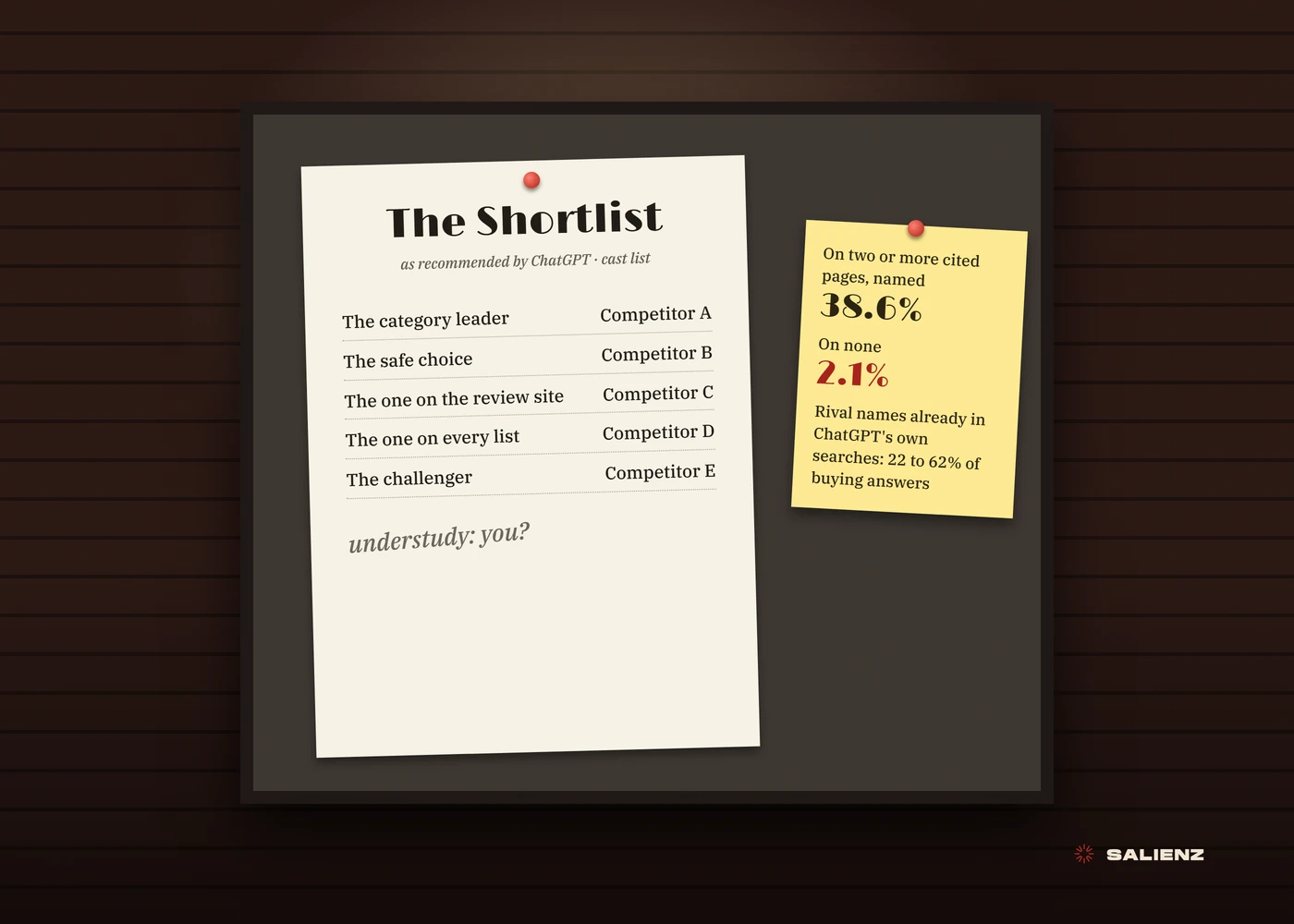
Find the specific lists the assistants cite for your buyers' questions, then work through them in order: ask independent authors to include you with evidence they can check, get onto vendor-written lists as an entry rather than the winner, and publish an honest comparison of your own. In our study, a company on two or more cited pages was named 38.6 percent of the time, and on none, 2.1 percent. 3
A listicle is a ranked or grouped list article, such as "the 10 best compliance automation tools". AI assistants lean on them for shortlist questions because one page names many vendors at once.
How much do AI shortlists depend on listicles?
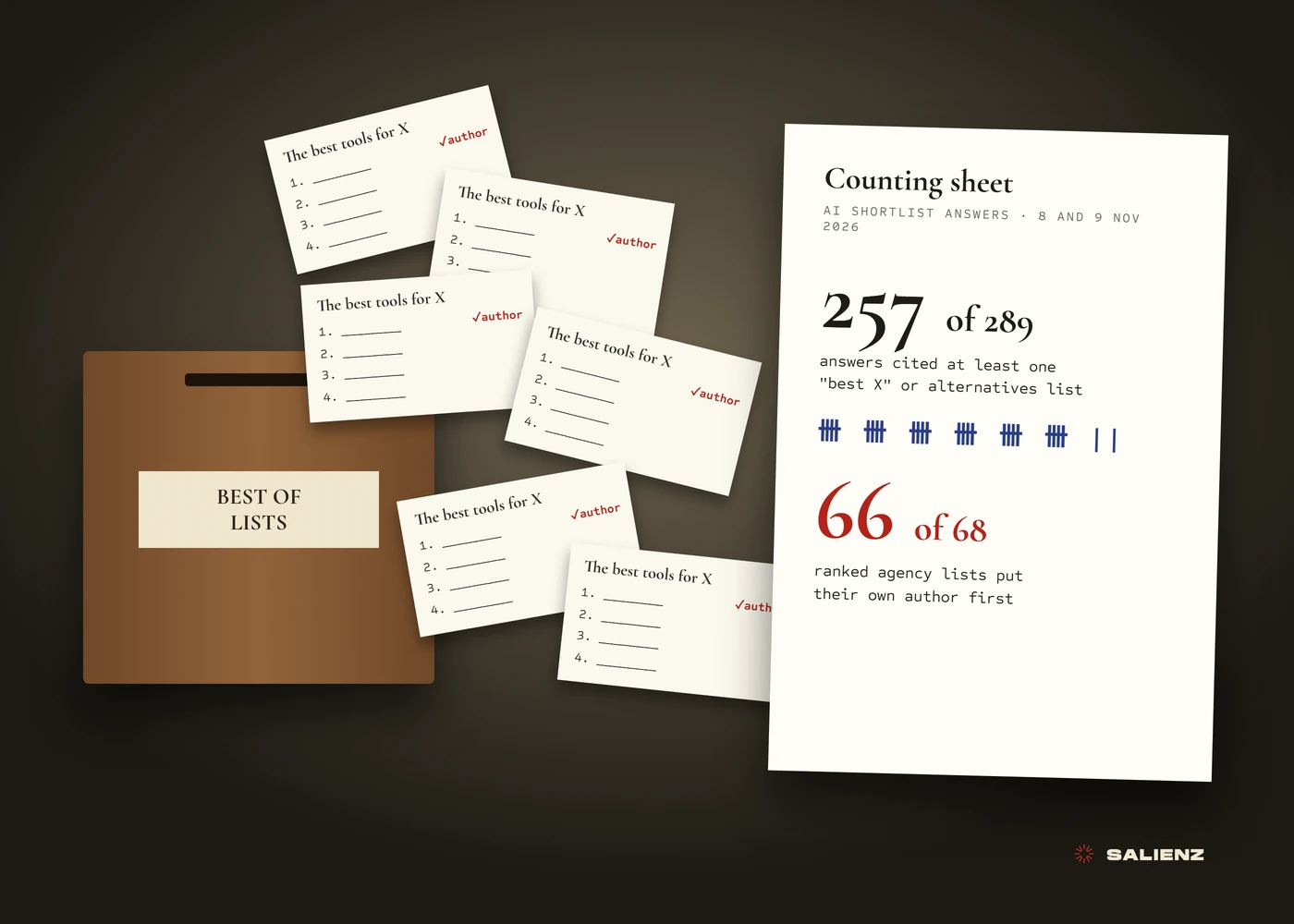
Heavily, at least in the category we can measure best, our own. On 8 and 9 November 2026 we tracked AI answers to shortlist, industry and alternatives questions about AI visibility agencies. Of 289 answers, 257 cited at least one page whose address marks it as a best-of or alternatives list, and those answers drew on 731 different list pages. 2
Most of those lists were written by a seller. 206 of the answers cited a list published by an agency in our index, and 258 of the 731 pages sat on agencies' own sites. When we read 68 ranked lists by agencies for the index, 66 put their author first. A vendor that is not on these pages is not in the material the assistant reads. 1 2
Why does being on more cited pages matter so much?
Because assistants mostly name companies the cited pages mention. In our study of 18,656 answers across four software markets, a company on none of an answer's cited pages was named 2.1 percent of the time. On one cited third-party page that rose to 19.5 percent, and on two or more to 38.6 percent. A fresh sample in November 2026 showed the same order. 3
How do you get into a listicle, step by step?
- 01Map the lists. Ask the assistants your buyers' shortlist questions, several times each, and record every list page they cite. Rank the pages by how often they appear. A handful usually carries most of the weight.
- 02Sort them by author. A publisher, analyst or independent reviewer can include anyone. A competitor's own list will rank itself first, and the most you can ask for is a fair entry.
- 03Read each author's inclusion rule. Many lists include only vendors the author can check from public pages: pricing, a product page for the use case, reviews, integrations. Make those pages exist and say what the list needs.
- 04Pitch with evidence. Send the author the facts they would need to write your entry, with links, and a reason their readers need you on the list. Thin pitches get ignored.
- 05Do not pay for an undisclosed placement. Google treats paying for links that pass ranking credit as link spam; sponsored placements are fine when the link carries rel="sponsored" or rel="nofollow". 4
- 06Publish your own comparison. A plain page on your site comparing you with the alternatives, with prices and a disclosure that you wrote it, gives assistants an exact answer to cite.
- 07Recheck every month. Lists are updated, new ones appear, and assistants change which ones they cite.
Should you publish your own "best X" list?
Yes, if you are honest about it. Assistants cite vendor-written lists all the time, as our tracking shows, so a clear comparison page on your own site is part of the material they read. Say that you wrote it, put your own entry where you choose, and give every competitor a fair, checkable description. A list that hides its author or misstates rivals is easy to discredit. 2
Where does Salienz fit?
Mapping the cited lists is the first step of our audit, and getting clients onto them is part of both retainers: Domination includes up to 15 listicle placements a term and Expansion up to 25, alongside the pages on the client's own site. Retainers start at $5,499 a month on a 3-month minimum. 5
Related: how B2B SaaS companies improve visibility in AI search, why ChatGPT recommends your competitors, and the AEO Agency Index.
Questions buyers ask
Receipts
05 sources- 01Salienz, AEO Agency Index107 agencies selling AI visibility work to B2B companies, read from their own sites on 3 November 2026, every price read at least twice. The pool every agency here was drawn from, and the source of each listed price.Last checked 3 November 2026
- 02Salienz, tracked answers, 8 and 9 November 2026Our own tracking of shortlist, industry and alternatives questions about AI visibility agencies. 257 of 289 answers cited at least one "best" or "alternatives" list page; 206 cited a list written by an agency in our AEO Agency Index; 731 distinct list pages were cited, 258 of them on index agencies' own sites.Last checked 9 November 2026
- 03Salienz, How can B2B SaaS companies improve visibility in AI search results?Across 18,656 tracked AI answers in four software markets in October 2026, a company on none of an answer's cited pages was named 2.1 percent of the time, on one cited third-party page 19.5 percent, on two or more 38.6 percent; confirmed in the same order on a fresh sample in November 2026.Last checked 8 November 2026
- 04Google Search Central, spam policies for Google web searchPage last updated 28 August 2026, read 9 November 2026. Buying or selling links for ranking purposes, including money or products for posts with links, is link spam; paid or sponsored links are allowed when qualified with rel="sponsored" or rel="nofollow".Last checked 9 November 2026
- 05Salienz pricingThe free audit, the $800 Foundation audit, Domination at $5,499 a month for roughly $5M to $20M ARR and Expansion at $8,499, on a 3-month minimum, with one client per product sub-niche.Last checked 9 November 2026