How do cybersecurity companies get recommended by AI models?
A cybersecurity company gets recommended by an AI model in one of two ways. Either the model already knows the name and puts it on the shortlist, or the company has a page that answers the buyer's exact question when the model searches. The big names win the first way. Everyone else has to win the second, and the second works differently on every assistant, because each one reads a different part of the web.
That is what we found when we read 7,385 answers from seven AI assistants to vulnerability management and security awareness questions. Google's AI Overviews leaned on Reddit and YouTube. Google AI Mode and Gemini leaned on Gartner. ChatGPT leaned on G2 and the vendors' own sites. Copilot leaned on roundup articles, and Claude mostly answered without citing anything. 1
| AI assistant | What it leaned on most | Named vendor's own site cited |
|---|---|---|
| ChatGPT | G2 (34% of recommendation answers) and vendors' own pages | 40% |
| Perplexity | G2 (30%) and Reddit (26%) | 37% |
| Google AI Overviews | Reddit (51%) and YouTube (38%) | 29% |
| Google AI Mode | Gartner (44%) and Reddit (23%) | 26% |
| Gemini | Gartner (43%) | 14% |
| Microsoft Copilot | Roundups and comparisons (66% of citations) | 10% |
| Claude | Its own knowledge: a source in 7% of answers | 1% |
How was the study run?
The AI Security Shortlist Study ran in October 2026. Each company had a fixed set of buyer questions, asked once a day for seven or eight days on seven AI surfaces: ChatGPT, Claude, Perplexity, Microsoft Copilot, Gemini, Google AI Mode and Google AI Overviews. We kept the 155 questions that name no company and read every answer for the vendors it named and the pages it cited. An answer counts as a recommendation answer when it names at least three of the category's vendors. Every figure is laid out on the study's data page. 1
| Company | Category | Questions | Answers | Recommendation answers |
|---|---|---|---|---|
| A | Vulnerability management | 78 | 3,435 | 553 |
| B | Security awareness training | 77 | 3,950 | 694 |
| Both | 155 | 7,385 | 1,247 |
Do AI models decide the shortlist before they search?
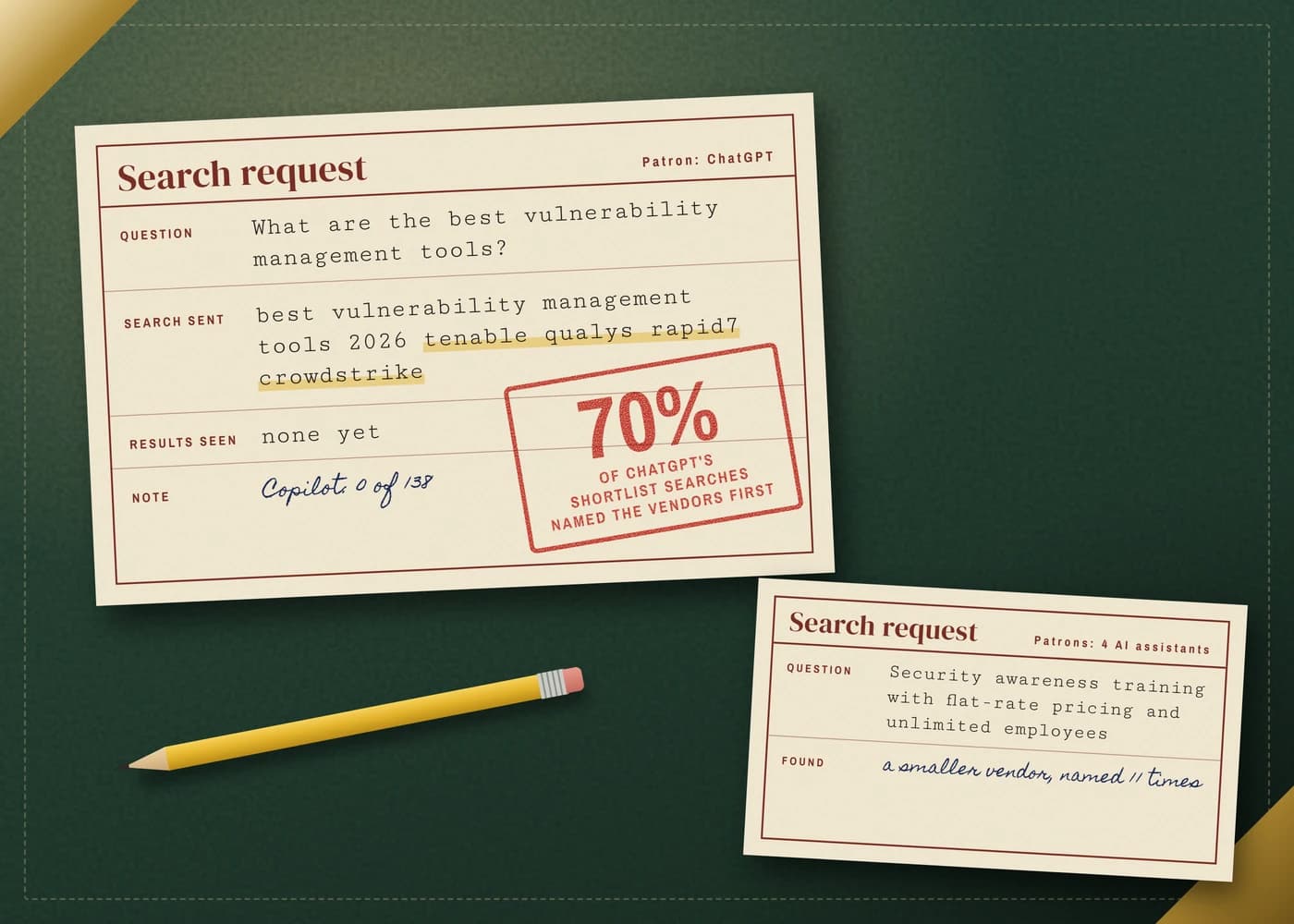
Some AI models decide the shortlist before they search and some do not, and the difference shows in their searches. Two of the assistants, ChatGPT and Microsoft Copilot, expose the searches they run. Of ChatGPT's 93 searches for the best tools in these categories, 65, or 70 percent, already named specific vendors before a result came back. Of Copilot's 138, none did. 1
Asked for the best vulnerability management tools, ChatGPT searched for "best vulnerability management tools 2026 tenable qualys rapid7 crowdstrike", a check on a list it had already written. Copilot searched for the category and read what came back, which is why two thirds of the citations in its recommendation answers went to roundups and comparison pages. ChatGPT added the year to 59 percent of its shortlist searches and Copilot to 25 percent.
Claude sits at the far end. It cited a source in 7 percent of its answers and was the most willing to recommend: 37 percent of its answers named at least three vendors, against 17 percent across all seven assistants. It named KnowBe4 in 59 percent of its security awareness answers and Tenable in 42 percent of its vulnerability management answers, and it never named either of the two companies in the study.
Which cybersecurity vendors do AI models recommend?
AI models recommend the incumbents, on every assistant. Across the 7,385 answers, the four most-named vendors in each category took 5,539 of the 6,203 namings of the vendors the two companies track, 89 percent. In security awareness those were KnowBe4, Proofpoint, Hoxhunt and Mimecast. In vulnerability management they were Qualys, Tenable, Rapid7 and ServiceNow. 1
How hard each assistant leaned on the leader varied far more than the ranking did. Claude named KnowBe4 in 59 percent of security awareness answers, while Perplexity named it in 11 percent. An assistant that answers from what it already knows concentrates on the leaders. One that searches and cites spreads its recommendations wider. Glen Allsopp's study of more than 70,000 ChatGPT and Google AI Overviews answers found the brand named most often for a question appeared on 82 percent of days in ChatGPT. 2
| AI assistant | KnowBe4, security awareness | Tenable, vulnerability management |
|---|---|---|
| Claude | 59.4% | 41.6% |
| Google AI Mode | 32.8% | 21.3% |
| Gemini | 32.3% | 18.7% |
| Microsoft Copilot | 31.0% | 18.1% |
| Google AI Overviews | 28.4% | 17.6% |
| ChatGPT | 27.9% | 19.9% |
| Perplexity | 10.5% | 5.8% |
Which sources does each AI model read before it recommends?
Each assistant read a different mix, and the differences are large enough to change where a company should spend its time. In the 1,247 answers that recommended at least three vendors, Reddit, YouTube, Gartner and G2 showed up at very different rates depending on who was answering. 1
| AI assistant | Recommendation answers | YouTube | Gartner | G2 | Roundups and comparisons | |
|---|---|---|---|---|---|---|
| Google AI Overviews | 86 | 51.2% | 38.4% | 30.2% | 7.0% | 31.5% |
| Google AI Mode | 117 | 23.1% | 9.4% | 44.4% | 4.3% | 21.6% |
| Perplexity | 46 | 26.1% | 0% | 10.9% | 30.4% | 52.2% |
| Gemini | 154 | 5.8% | 0% | 42.9% | 9.7% | 59.5% |
| ChatGPT | 201 | 1.0% | 0% | 20.4% | 34.3% | 34.2% |
| Microsoft Copilot | 211 | 0% | 0% | 0% | 7.1% | 66.3% |
| Claude | 432 | 0.5% | 0% | 0% | 1.2% | 16.7% |
The common advice that Reddit decides AI recommendations is true for Google's surfaces and Perplexity, and close to irrelevant for ChatGPT and Copilot on these questions. Review sites matter on most of them, which matches what buyers say: in G2's survey of 1,076 B2B software buyers, 45 percent said citations from review sites were the signal that made them most confident in an AI recommendation. G2 runs a review site, so it has a stake in that answer. 3
It matters because buyers act on these answers. In the same survey, 51 percent of buyers said they now start software research in an AI chatbot more often than in Google, 69 percent said a chatbot led them to a different vendor than they had planned, and a third bought from a vendor they had never heard of. 3
How does a smaller cybersecurity company get recommended?
A smaller cybersecurity company gets recommended by owning a narrow question the incumbents' pages do not answer, and by having its own page found. On six of the seven assistants, a vendor outside each category's four most-named was more likely than the leaders to have its own site cited in the answer that named it: 33 percent against 15 percent across all seven. ChatGPT was the exception, citing the vendor's own site about 40 percent of the time either way. 1
Company B shows the pattern. B was named in 26 of its 3,950 answers, and B's own site was cited in 20 of those 26. Every one of the 26 came from six questions with a constraint attached: training inside Slack or Microsoft Teams, Slack instead of a separate learning system, Teams without a separate login, flat-rate pricing with unlimited employees, no dedicated admin, and training generated from a company's own policies. The flat-rate pricing question alone brought 11 namings across four assistants. B had a page for each. On the broad questions, such as "Best security awareness training platforms", B did not appear on any assistant.
Why doesn't educational content get you recommended?
Educational content earns citations rather than recommendations, because the assistants use it as evidence and recommend somebody else. Company A's website was cited in 199 of its 3,435 answers across the seven assistants, and A was named in 9. On ChatGPT, 79 of the 99 answers citing A used its educational guides on metrics, remediation deadlines and exposure management. 1
The assistants read A's guides, took the definitions and the numbers, and recommended Qualys, Tenable and Rapid7. To turn a citation into a recommendation, a guide has to say plainly what the company sells, who it is for and how it differs, in words an assistant can lift into a shortlist. How much a citation without a name hides from a typical audit is covered in when you need an AI visibility audit, and when you need a retainer.
What should a cybersecurity company do first?
Start with what every assistant shares, then work on the sources your buyers' assistants read.
- 01Let the assistants in. OpenAI says sites that opt out of its search crawler, OAI-SearchBot, will not be shown in ChatGPT search answers, and recommends allowing it in robots.txt. 4
- 02Write a page for each narrow question your product wins: an integration, a pricing model, a deployment constraint, a company size. That is how company B was named, and it works on every assistant that searches.
- 03Get into the roundups and comparisons the assistants read. They carried two thirds of Copilot's recommendation citations and over half of Gemini's and Perplexity's.
- 04Keep your Gartner Peer Insights and G2 profiles current. Gartner led on Google AI Mode and Gemini, and G2 on ChatGPT and Perplexity.
- 05If your buyers use Google, take Reddit and YouTube seriously. They were cited in half and over a third of Google AI Overviews' recommendation answers.
- 06Earn the coverage that puts your name in the models' memory: analyst reports, press and lists. Claude and ChatGPT both started from names they already knew.
- 07Connect educational content to the product. Say what you sell and who it is for on the pages the assistants already cite.
What did the study not cover?
- Two categories, two companies' question sets and about a week of answers. Other categories and longer windows could differ.
- Some surfaces returned fewer answers on some days, and Google AI Overviews only answers when Google shows an overview.
- Only ChatGPT and Microsoft Copilot expose their searches, so the shortlist-search figures cover those two.
- Page types are as our tracking tool classified them, and "recommendation answer" is our own definition: at least three vendors named.
Common questions
Receipts
04 sources- 01The AI Security Shortlist StudyRun in October 2026. Two cybersecurity companies (names withheld): A in vulnerability management, B in security awareness training. 155 questions that name no company, asked once a day for seven or eight days on ChatGPT, Claude, Perplexity, Microsoft Copilot, Gemini, Google AI Mode and Google AI Overviews: 7,385 answers. Eight ChatGPT answers carrying content unrelated to the question were left out. A vendor counts as named when its name is in the answer's own words. Recommendation answers name at least three of the category's tracked vendors. Searches are the ones ChatGPT and Copilot exposed for these questions; shortlist searches ask for the best or top tools, platforms or vendors. Source of every figure on this page not credited to another source. The link opens the data page.Last checked 17 October 2026
- 02Detailed, How volatile are AI responses?Glen Allsopp. More than 70,000 answers to 1,300+ commercial prompts, checked once a day for 28 days in ChatGPT and Google AI Overviews. Source of the leading brand for a prompt appearing on 82 percent of days in ChatGPT.Last checked 16 October 2026
- 03G2, New G2 Research: Half of B2B Software Buyers Now Start Their Research With AI ChatbotsPress release, April 2026, on a March 2026 survey of 1,076 B2B software buyers and decision-makers. Source of the 51 percent who start research in an AI chatbot more often than Google, the 69 percent who chose a different vendor than planned, the third who bought from a vendor they had never heard of, and the 45 percent who called review-site citations the most confidence-inspiring signal. G2 operates a software review site.Last checked 17 October 2026
- 04OpenAI, Overview of OpenAI CrawlersStates that OAI-SearchBot is used to surface websites in ChatGPT's search features, that sites opted out of it will not be shown in ChatGPT search answers though they can still appear as navigational links, and recommends allowing it in robots.txt and from OpenAI's published IP ranges.Last checked 17 October 2026