What does an AI visibility audit cost?
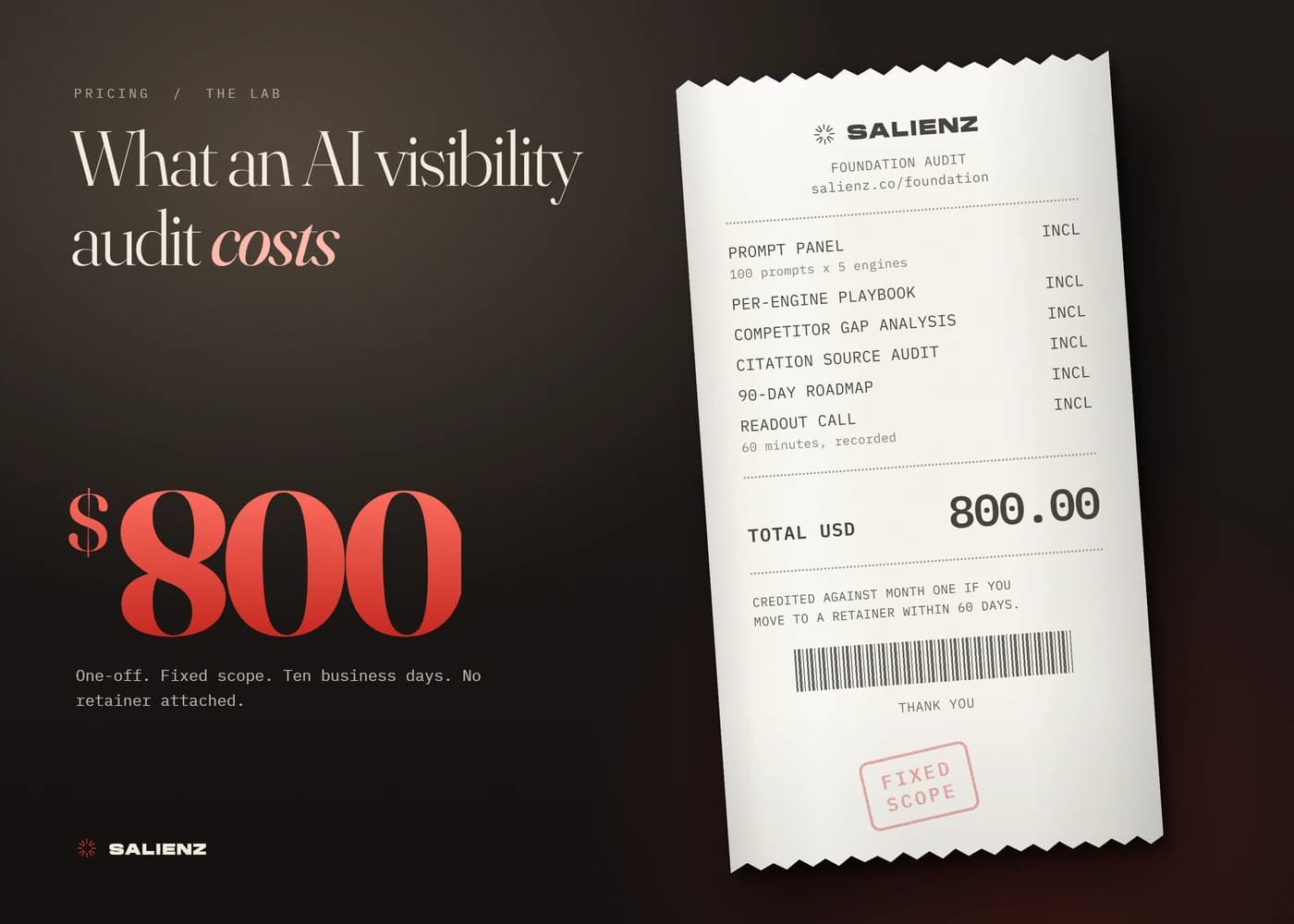
An AI visibility audit from Salienz costs $800, charged once, with no commitment to anything afterwards. Delivery is ten business days. The scope is fixed before you pay, so the figure does not move once work starts.
| Component | What it contains |
|---|---|
| Prompt panel | 100 buyer prompts run across five answer engines |
| Per-engine playbook | What each engine is doing differently for your category |
| Competitor gap analysis | Who is being named instead of you, and for which prompts |
| Citation source audit | Which pages the engines quoted, and who controls them |
| 90-day roadmap | The ordered list of what to fix, with the reasoning |
The five engines are ChatGPT, Perplexity, Google, Claude and Microsoft Copilot, and Google is measured on three surfaces: AI Overviews, AI Mode and Gemini. Each prompt runs multiple times per engine in fresh logged-out sessions, because generation is non-deterministic and a single run proves nothing. In Salienz's Audit Size Test, two readings of an unchanged brand built on 15 questions differed by 2 points or more in up to 44 percent of draws, against 7 percent or less for a set of 90. A one-off screenshot of an engine naming you is not evidence that it happens reliably, and the point of paying for a baseline is to replace that screenshot with a rate.
The audit exists because most companies buying this work cannot describe their starting position. They have seen one screenshot of ChatGPT naming them and have no idea whether that happens 2 percent of the time or 40 percent. Without a baseline captured before any work begins, nothing you do afterwards is attributable to what you paid for.
The audit also records every domain the engines cited, not only whether you appeared. That is the part buyers tend not to ask for and the part that turns out to matter, because the list of pages an engine reaches for in your category is the target list for everything that follows.
The audit is sold without a retainer attached on purpose. If the finding is that your position is already strong, the correct outcome is that you do not buy anything else. The full scope sits on the Foundation page.
What do AI visibility agencies charge per month?
Salienz retainers are $5,499 and $8,499 per month, both on 90-day terms, with the audit included in either. There is no annual lock-in and no separate onboarding fee.
| Tier | Price | Term | Cite-ready assets | Listicle placements | Guest posts and PR |
|---|---|---|---|---|---|
| Foundation (audit) | $800 | One-off, 10 business days | Not applicable | Not applicable | Not applicable |
| Domination | $5,499 / month | 90 days | 30 per term | Up to 15 | 6 per term |
| Expansion | $8,499 / month | 90 days | 45 per term | Up to 25 | 12 per term |
Both retainers include the audit, Reddit community seeding, and a monthly performance report with attribution. Domination adds two technical SEO fix cycles per quarter. Expansion adds schema and entity foundation work. What each one delivers month by month is set out on the services page.
What moves the price?
The gap between $5,499 and $8,499 is placement volume, not consulting hours. Expansion buys 25 listicle placements against Domination's 15, twelve guest posts or digital PR placements against six, and 45 cite-ready assets against 30.
That structure follows from where citations come from. Answer engines quote third-party pages heavily, and those are pages you do not control. Buying more of the work that operates on other people's pages is what the higher tier is for. Buying more blog posts on your own domain is not, which is why the asset count moves by five between tiers while the placement count moves by ten.
Two things push a given engagement toward the upper tier. The first is how many competitors are already entrenched, because displacing a vendor that appears in most answers for your category takes more placements than entering a category where nobody has been named consistently. The second is how much repair your entity data needs before placement work compounds, which covers inconsistent company descriptions, a thin Crunchbase entry and a missing Wikidata record.
The ARR bands attached to each tier are guidance rather than gates. Domination is built around companies at roughly $5M to $20M ARR and Expansion around $20M to $30M. The number that should decide it is how much off-site placement your category needs.
Should you buy an audit or a retainer?
Buy the audit alone when you do not know your starting position. Buy a retainer when you already know you are absent from answers your competitors appear in and you have budget approved for at least a quarter. The audit is included in both retainers, so buying it first costs you nothing if you upgrade within 60 days of delivery, when the $800 comes off your first month.
| Your situation | What to buy |
|---|---|
| Want a first reading before spending anything | Free audit, if we accept the request |
| No baseline, no idea how often you are named | Audit only, $800 |
| Have a baseline, want to know if it is worth acting on | Audit only, then decide |
| Absent from answers, budget approved, need placement volume | Domination, $5,499 |
| Absent from answers, crowded category, board reporting on this | Expansion, $8,499 |
| Agency already engaged and nothing is moving | Audit only, as a second opinion |
If you are not ready to pay for a baseline, Salienz also runs a free AI visibility audit for the brands it accepts after reading the request. It asks 15 buyer questions three ways across five engines, which comes to 195 answers, and returns the five things to fix first 48 business hours after confirmation. It is enough to show you where you stand. It is not enough to plan a quarter of work around, which is what the $800 audit is for. What each size of audit can and cannot tell you, measured, is in when you need an AI visibility audit, and when you need a retainer.
Salienz does not sell per-project pricing beyond the audit, and the reason is mechanical rather than commercial. Listicle placement, review velocity and community presence take weeks to be published, crawled and picked up, and most new pages are never cited at all: in Semrush's test of 81 new pages on its own blog, ChatGPT search was citing 34 after 30 days. A one-month project ends before the thing you paid for can be told apart from noise. Selling that as a project would mean selling something nobody can evaluate inside its own term.
Anything shorter than a quarter is priced to be unmeasurable.
How does that compare to other AI visibility audits?
Across the four sellers tracked here, a standalone AI visibility audit with a published price costs between $249 and $3,500. Foundation is the cheapest of the three sold as an engagement, and one report product undercuts it. Every figure below was re-read from the seller's own page on 18 October 2026, and anything a seller did not publish is marked as not published rather than estimated. Two rows changed between this table's first run on 10 August and 4 October, and none since. DerivateX no longer lists the $750 audit it sold then, and its only one-off is now a $3,500 diagnostic. Red Engage, listed in August at $2,500, now shows only a free audit on its site, so that row is removed rather than carried. The Salienz free audit is listed first, because for the brands we accept it is the cheapest first reading on the table.
| Audit | Price | Prompts | Engines | Turnaround |
|---|---|---|---|---|
| Salienz free audit | Free, for brands we accept | 15, each asked three ways | 5 | 48 business hours |
| BizWhiz report | $249, one-off | 20 | 6 | Not published |
| Salienz Foundation | $800, one-off | 100 | 5 | 10 business days |
| NBound AI Visibility Audit | From £2,500, one-off | 50 or more | 5 | 14 business days |
| DerivateX diagnostic | $3,500, one-off | Roughly 50 | 5 | Two weeks |
Two of those are not really the same purchase. BizWhiz at $249 sells a report rather than an agency engagement, and at that price it is the right answer for anyone who wants the numbers without a person attached to them. The DerivateX diagnostic sits at the other end: its $3,500 also buys a technical foundation plan and a three-month content strategy, which makes it closer to a strategy engagement than to a measurement. Three of the four credit the fee if you continue, NBound within 60 days of starting monitoring, DerivateX within 30 days of starting a retainer and Salienz within 60 days of delivery, so for those three the headline figure is a deposit rather than a cost.
The sticker price is still the wrong unit. An audit produces one observation per prompt per engine, so the thing you are buying is prompt-engine coverage, and dividing the fee by that count is the only way two of these compare. Nobody in this category publishes it, so here it is for the four paid audits above. The free audit is left out, since there is no fee to divide.
| Seller | Fee | Prompts | Engines | Per prompt | Per prompt-engine |
|---|---|---|---|---|---|
| Salienz Foundation | $800 | 100 | 5 | $8.00 | $1.60 |
| BizWhiz | $249 | 20 | 6 | $12.45 | $2.08 |
| NBound | £2,500 / $3,334 | 50 or more | 5 | $66.68 | $13.34 |
| DerivateX | $3,500 | Roughly 50 | 5 | $70.00 | $14.00 |
What do the monitoring tools cost?
The monitoring tools in this category publish their rates, and the spread is wider than most buyers expect. These figures were re-read from each vendor's own pricing page on 18 October 2026. Since the 4 October reading, Evertune has added a $60 entry plan and moved its Pro plan to annual billing, and Rankscale lists a yearly-only Essentials plan from $17 a month.
| Tool | Entry tier | Mid tier | Top published tier |
|---|---|---|---|
| Knowatoa | $59 / month | $199 / month | Enterprise, not published |
| Peec AI | $95 / month, 50 prompts | $245 / month, 150 prompts | $495 / month, 350 prompts |
| Rankscale | $99 / month, 1,200 credits | $229 and $385 / month, 3,000 and 5,500 credits | $780 / month, 12,000 credits |
| Scrunch AI | $250 / month, 125 prompts | Not published | Not published |
| Evertune | $60 / month, 5,000 prompt credits | Not published | $800 / month, 100,000 prompt credits |
That gap is not a pricing anomaly. The tools count different things: prompt volume, model coverage, and credit systems that convert to wildly different numbers of actual queries. Two tools quoting the same monthly figure can be checking an order of magnitude apart in real coverage.
None of those numbers measure the same purchase as a retainer. Monitoring tools tell you whether you are named. They do not change whether you are named, and a $95 per month subscription and a $5,499 per month retainer are not competing offers. If a comparison puts them side by side as alternatives, it is comparing measurement to intervention. What each one covers, now that some tools also draft pages, is set out in AI visibility software or an agency.
How do you compare two AI visibility quotes?
Normalise two quotes to the same unit before you compare them. A tool's headline price tells you almost nothing on its own, so divide the monthly fee by the number of prompts the plan actually runs, then account for how many engines it covers. Peec AI at $95 for 50 prompts and Evertune at $800 for 100,000 prompt credits across 11 models, billed annually, are not the same product priced differently.
Credit systems make this harder. Rankscale sells 1,200 credits at $99 and 12,000 at $780, which is a better rate per credit at the top tier, but a credit is a query against an engine rather than a prompt you chose to track. Read what a credit buys before comparing two credit-based plans.
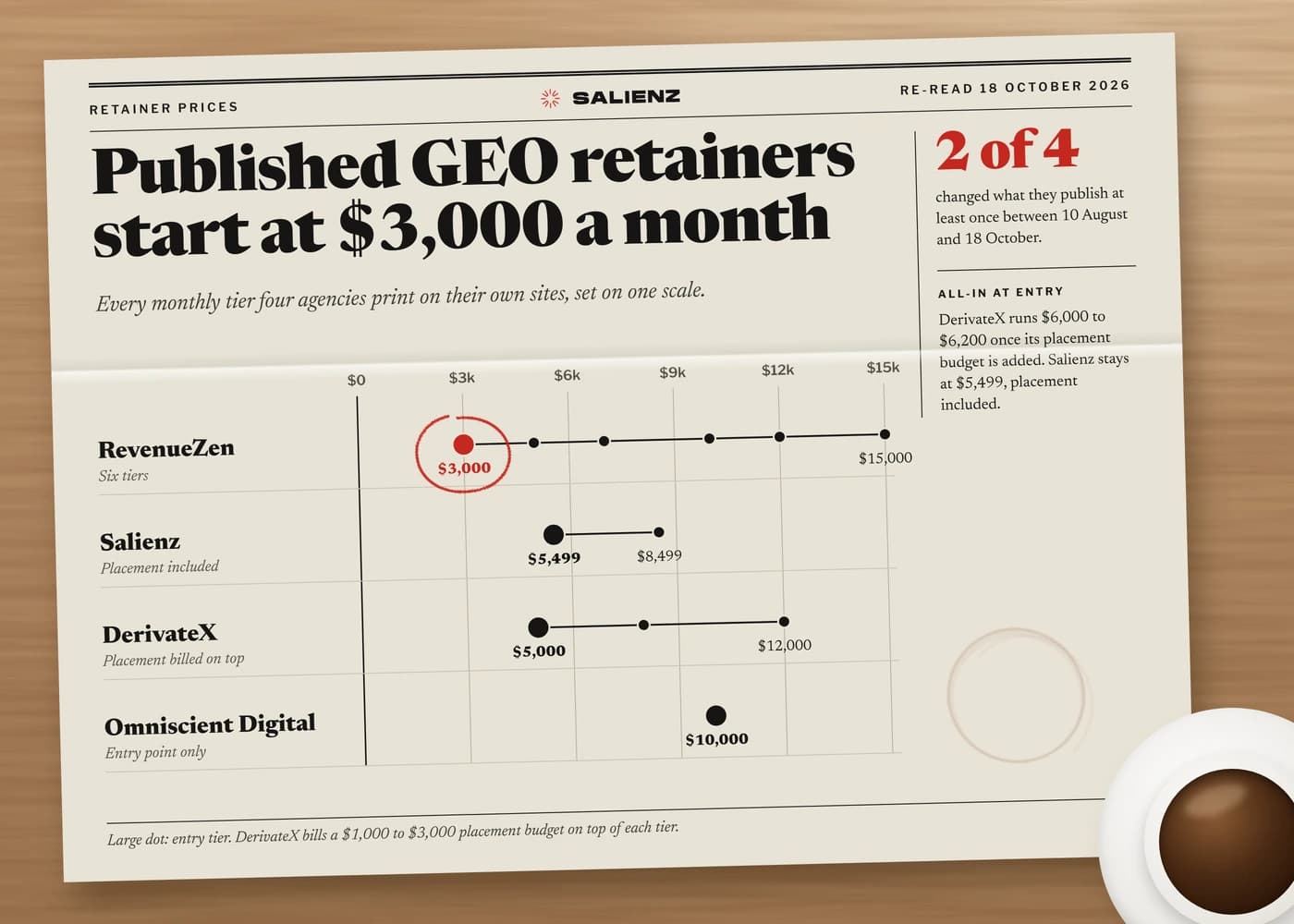
For agency quotes the equivalent unit is placement counts, not hours. Ask every vendor how many listicle placements, guest posts and digital PR placements are included per month, and quotes that looked comparable stop being comparable. Hours tell you what a vendor spends. Placements tell you what you get, and placement volume is what produces citations. The published rates from four agencies, and the same calculation run across them, are in what GEO agencies actually charge per month.
Ask the second question too: is the placement budget inside the retainer or outside it. Some agencies quote a retainer and bill PR and backlink placement separately on top, which is defensible because placement cost varies by target, but it means the published figure is not the price. Add the stated placement range to the retainer before putting two quotes side by side, and some of the cheaper-looking options move above the dearer ones. Salienz, a GEO agency, includes placements in the retainer, which is why its headline figure is the whole price and the ceiling on volume is fixed.
The last comparison worth running is against doing the work in-house. Up to 25 listicle placements and 12 guest posts or digital PR placements a quarter is a standing outreach workload rather than something absorbed alongside another job, so the question is whether you would rather hire for it.
When is this not worth buying?
Do not buy AI visibility work if you are pre-product-market fit, if your category has no meaningful prompt volume yet, or if you cannot commit to a full quarter. In each case the work gets executed properly and wasted commercially, because the lag between placement and citation outruns your ability to act on the result.
- You need pipeline this month. Paid search will do more for a quarter-end number than anything on this page, because off-site placement takes weeks to be picked up and a quarter to read reliably.
- Your category genuinely has no prompt volume. The audit will tell you for $800, which is the cheapest way to find out, and the correct response to that finding is to wait rather than to buy a retainer.
- You are already named in most answers for your core prompts. The marginal return on a retainer is small, so track it quarterly and put the budget somewhere else.
- What you want is a dashboard showing a visibility score. Buy one of the monitoring tools above for a tenth of the price, because it will do that job well.
There is also a case where a competitor is the better choice. If you need coverage across a dozen international markets at once, an agency with in-market teams will serve you better than a single operator, because placement volume from one source does not compensate for having no local-language presence. Salienz also works with one client per category, so if that slot is taken in your category, you should be talking to somebody else.
Common questions
Receipts
12 sources- 01Knowatoa pricingPublished plan rates, Starter and Growth tiers. Retrieved from the vendor's own pricing page.Last checked 18 October 2026
- 02Peec AI pricingPublished plan rates with prompt allowances for Starter, Pro and Advanced.Last checked 18 October 2026
- 03Rankscale pricingPublished plan rates with monthly credit allowances: Pro $99 for 1,200, Pro+ $229 for 3,000, Growth $385 for 5,500 and Enterprise $780 for 12,000. Pro+ was added between August and October, and on 18 October the comparison table also listed an Essentials plan from $17 a month, yearly only.Last checked 18 October 2026
- 04Scrunch AI pricingPublished Core tier rate and prompt allowance. Higher tiers are not published.Last checked 18 October 2026
- 05Evertune pricingRe-read in the browser on 18 October 2026. Starter at $60 a month with 5,000 prompt credits and up to five models, and Pro at $800 a month billed annually with 100,000 prompt credits, 11 models and 25 articles a month from its Content Agent. Both plans include an agent that runs ChatGPT ads. Enterprise is custom.Last checked 18 October 2026
- 06DerivateX pricingRe-read in a browser on 4 October 2026. The $750 AI Visibility Score Audit listed in August is gone, and the page states there is exactly one one-time product: a $3,500 diagnostic delivered in two weeks, with an AI perception audit across ChatGPT, Perplexity, Gemini, Claude and Google AI Overviews and a query map of roughly 50 priority buyer queries, credited in full against the first retainer month within 30 days.Last checked 18 October 2026
- 07BizWhiz audit cost pageStates a $249 one-time report and $99 a month for tracking, run as 20 localized prompts across 6 AI systems producing 100 or more answers per audit, returning share of voice, a citation source inventory and prioritized fixes. No turnaround is stated.Last checked 18 October 2026
- 08NBound AI visibility audit guideStates NBound's own audit at from £2,500, with 50 or more approved prompts across five platforms, delivered in 14 business days, and the fee credited if monitoring starts within 60 days.Last checked 18 October 2026
- 09Red EngageListed in the August table with a $2,500 audit. On 4 October 2026 its site offered a free GEO audit and showed no priced one, so the row was removed. Still the case on 18 October.Last checked 18 October 2026
- 10Salienz rate cardFoundation, Domination and Expansion rates as published on the pricing pages of this site.Last checked 18 October 2026
- 11GBP to USD reference rate1 GBP to 1.3335 USD, European Central Bank reference rate for 16 October 2026, the latest published when the table was rebuilt on 18 October, used only to convert the NBound audit fee for the per-unit table.Last checked 18 October 2026
- 12Semrush, how fast AI search platforms cite new content81 test pages on the Semrush blog, tracked daily for 30 days in ChatGPT search and Google AI Mode, published 10 December 2025. Source of ChatGPT search citing 34 of the 81 pages, 42 percent, at day 30.Last checked 18 October 2026