Do GEO agencies publish their pricing?
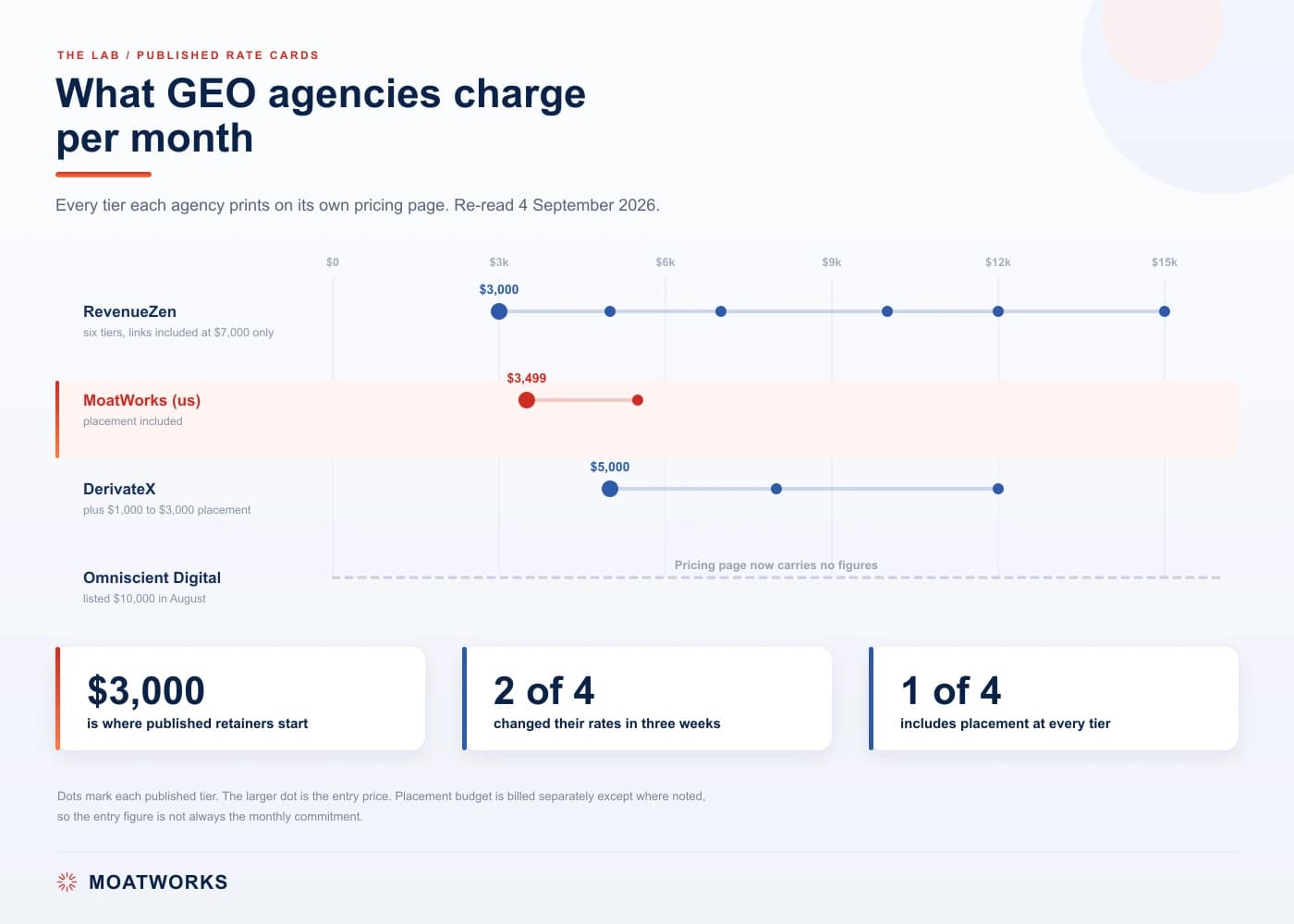
Some do. The stock line in this category is that everyone hides behind a custom quote, and it is not true. Of the agencies checked on 10 August 2026, two competitors published a complete rate card on their own site with no form in front of it, and a third published an entry point without a tier breakdown.
What is true is narrower and more useful. The number an agency publishes is frequently not the number you end up paying, because the largest variable cost in this work is often quoted separately from the retainer that appears on the pricing page.
What do the agencies that publish actually charge?
Every figure below came from the agency's own pricing page on 10 August 2026. Rate cards move, so treat the date as part of the number.
| Agency | Entry | Published tiers above entry | Placement budget |
|---|---|---|---|
| RevenueZen 2 | $3,000 | $5,000, $7,000, $10,000, $12,000, $15,000 | Link building included at $7,000, an add-on above |
| Salienz | $3,499 | $5,499 | Included in the retainer |
| DerivateX 1 | $5,000 | $8,000, $12,000 | Billed on top, $1,000 to $3,000 |
| Omniscient Digital 3 | Withdrawn | Its pricing page now carries no figures | Not stated |
RevenueZen publishes the widest ladder in the group, six tiers from $3,000 to $15,000, which is the clearest public statement anyone in this category makes about what more money buys, and it is the one to read first if you want to see how scope scales with spend. DerivateX publishes three tiers plus two one-off products, including a $750 standalone audit that is compared against ours in what an AI visibility audit costs. Omniscient Digital states a $10,000 entry point for full-service engagements and stops there, which is a reasonable thing to do when engagements are genuinely scoped per client.
The bands overlap between $3,000 and $12,000, so the monthly figure on its own tells a buyer very little. Three agencies whose entry tiers sit inside a $2,000 spread are not offering the same work at slightly different prices, and the differences that matter sit in what the retainer covers rather than in what it costs.
Why is the published retainer not the price?
Because placement costs money and somebody has to pay for it. Getting a brand into a roundup, a review platform or a guest post usually involves paying the publisher, and an agency can either absorb that inside the retainer or bill it separately.
One agency in this group publishes what that costs. DerivateX states on its pricing page that off-site citation budgets sit outside the retainer at $1,000 to $1,200 per month on the entry tier, $1,500 to $2,000 in the middle, and $2,000 to $3,000 at the top, with every spend approved before it goes live. Billing it that way is defensible, because placement cost genuinely varies by target and a fixed allowance either overcharges some clients or starves others.
It does mean a published $5,000 is an all-in $6,000 to $6,200, and that comparing headline retainers across agencies compares numbers covering different work. Salienz includes placements in the retainer, which is why the headline figure is lower and why the monthly volume has a fixed ceiling of 15 placements on Domination and 25 on Expansion. Neither model is dishonest, but a budget built by reading one as though it were the other will be short by several thousand a month.
| Agency | Published entry retainer | Stated placement budget | All-in monthly |
|---|---|---|---|
| RevenueZen 2 | $3,000 | Link building not included at entry | $3,000 plus any link spend |
| Salienz | $3,499 | Included | $3,499 |
| DerivateX 1 | $5,000 | $1,000 to $1,200 | $6,000 to $6,200 |
| Omniscient Digital 3 | No longer published | Not stated | Not calculable |
The ordering changes once the column on the right exists. On headline retainers the two at the bottom of the range sit within $500 of each other. On all-in cost the cheapest and the second cheapest are separated by roughly $2,500 a month, which over a 90-day term is around $7,500 on an engagement most buyers were treating as equivalently priced.
Two of the four say nothing about placement budget either way, so those rows cannot be completed from public information. That is not an accusation. It is the reason to ask the question on the call rather than assume the published number is the whole of it.
What should be included in a GEO retainer?
Ask for the placement counts. Citations come from pages the client does not own, so the number of third-party surfaces an agency will get a brand onto each month is the unit that produces the result. Everything else is a means to it.
- How many listicle and roundup placements per month, and whether that is a target or a commitment.
- How many guest posts or digital PR placements, and who pays the publisher.
- Whether review platform work on G2 and Capterra is in scope, since those profiles are cited heavily and are slow to build.
- What measurement is included, how many prompts, across how many engines, and how many runs per prompt.
- Whether the reporting names competitors, because citation share against a named set is the only number that survives a board meeting.
An agency that answers all five in writing is easy to compare against another that does the same. An agency that answers in hours per month is describing its own costs rather than your outcome. Our own answers to all five are on the services page, which is the fairest way to ask other people for theirs.
How do you compare two agency quotes?
Add the placement budget to the retainer before anything else. A quote that excludes placement spend is not wrong to exclude it, but it is not the price, and adding it moves some of the cheaper-looking options above the dearer ones.
Then divide the all-in monthly figure by the committed output count. Two agencies at $5,000 a month where one commits to 10 deliverables and the other to 25 are $500 and $200 each, and nothing on either service page surfaces that.
Two agencies publish enough to run that calculation. Both quote a monthly count of published assets, so the all-in retainer divided by that count is comparable, and it is the closest this category currently gets to a like-for-like unit price.
| Agency and tier | All-in monthly | Assets per month | Cost per asset |
|---|---|---|---|
| Salienz Domination | $3,499 | 10 | $350 |
| Salienz Expansion | $5,499 | 15 | $367 |
| DerivateX Rank & Get Found | $6,000 to $6,200 | 10 or more | $600 to $620 |
| DerivateX Own Your Category | $9,500 to $10,000 | 15 or more | $633 to $667 |
| RevenueZen Foundation | $3,000 | 4 articles | $750 |
| RevenueZen Total Market | $15,000 | 12 to 15 or more | $1,000 to $1,250 |
| Omniscient Digital | No longer published | Not published | Not calculable |
Listicle placements resist the same treatment, because Salienz is the only agency in the group that publishes a count: 15 over a 90-day term on Domination and 25 on Expansion. That works out at almost exactly $600 a placement on both tiers, which is deliberate rather than a coincidence, since the higher tier is sold on volume rather than on a better rate. Nobody else publishes the number, so the column cannot be filled. That is the question to put on a call.
Check the commitment shape last. Terms in this group run from 90-day pilots to a six-month minimum on the largest engagements, and Salienz runs 90-day terms throughout. A longer minimum is not automatically worse, because this work has a six to twelve week lag before placements register in an answer, so a quarter is close to the shortest honest term anyone can offer. What is worth asking about is a long minimum with no published exit.
What does it cost to do this in-house instead?
The honest answer is that it depends on a number this page cannot source: what an outreach hire costs in your market. What can be said is what the job involves, because that is what the retainer is buying.
Twenty five listicle placements and four digital PR placements a quarter is a standing outreach workload rather than a task somebody absorbs alongside another role. It means maintaining a target list, pitching editors who mostly do not reply, correcting outdated entries in roundups that already exist, and keeping review velocity moving on two or three platforms. Add the placement spend on top, since publishers charge you the same whether an agency or an employee sends the email.
The case for doing it in-house is strongest when the category is narrow enough that the target list is short and stable, and one person can own the relationships permanently. The case for an agency is strongest when the list is long, the relationships already exist somewhere, and the work needs to start producing inside a quarter rather than after a hire. Either way the target list is what an $800 audit returns, and it is worth having before you decide who works it.
Common questions
Receipts
04 sources- 01DerivateX pricingRe-read in a browser on 4 September 2026 and repriced since this page first ran. Now $5,000, $8,000 and $12,000 a month against $3,500, $5,500 and $8,000 in August, plus a $3,500 one-time diagnostic and an individually scoped enterprise tier. Off-site citation budget is stated as separate from the retainer at $1,000 to $1,200, $1,500 to $2,000 and $2,000 to $3,000 by tier, against $1,500 to $8,000 in August. The 90-day pilots on the lower two tiers, the six-month minimum on the top one and the $5M ARR floor are unchanged.Last checked 4 September 2026
- 02RevenueZen pricingSix published monthly tiers: Foundation $3,000, Growth $5,000, Accelerate $7,000, Scale $10,000, Command $12,000 and Total Market $15,000.Last checked 10 August 2026
- 03Omniscient Digital pricingListed an entry point of $10,000 per month for full-service engagements in August, with no tier breakdown. Re-read on 4 September 2026, the pricing page renders with no figures on it at all, so the row is recorded as withdrawn rather than carrying a number the source no longer supports.Last checked 10 August 2026
- 04Salienz rate cardDomination at $3,499 per month and Expansion at $5,499 per month, both on 90-day terms with placements included.Last checked 10 August 2026