When do you need an AI visibility audit, and when do you need a retainer?
You need an audit to find out where you stand, and a retainer to change it. An audit asks AI assistants the questions your buyers ask and records whether they name you, who they name instead and which websites they quote. A retainer pays for the work on those websites, plus repeated measurement that shows whether the work moved anything. Between the two sits the question most buyers skip: how big the audit has to be.
| Option | Typical shape | What it tells you | What it cannot tell you |
|---|---|---|---|
| Small audit, often free | A handful of questions on a few engines, run once | Whether you are named, who leads, which sources matter | Your share of answers to within a few points, or whether you are improving |
| Full audit, usually paid | 90 to 100 questions across the engines, run once | A baseline accurate to about a point | Which of the places you appear will still be there next week |
| Retainer | The same full set re-run on a schedule, plus the work | Whether the work moved you, and where you are slipping | Nothing on its own if nobody inside owns the work |
How was the Audit Size Test run?
The Audit Size Test was run in October 2026. Each company had a fixed set of 100 buyer questions. We left out the 10 that name the company, kept the 90 that do not, and asked each of them once a day for at least seven days on seven surfaces: ChatGPT, Claude, Perplexity, Microsoft Copilot, Gemini, Google AI Mode and Google AI Overviews. An answer counts as an appearance when it names the company in its own words or cites the company's website. The figures use complete days only: a day whose run was still filling when the data was pulled was left out, so a half-finished day could not skew the results. That left 9,327 answers and 357 appearances.
| Company | Category | Days tracked | Complete days used | Answers | Appearances | Share of answers | Lowest and highest day |
|---|---|---|---|---|---|---|---|
| A | Cybersecurity software | 7 | 5 | 3,066 | 152 | 5.0% | 4.3% to 5.6% |
| B | Cybersecurity software | 8 | 6 | 3,756 | 49 | 1.3% | 1.0% to 1.4% |
| C | Healthcare practice software | 7 | 4 | 2,505 | 156 | 6.2% | 5.4% to 7.0% |
We then simulated two sizes of audit. A small audit is 15 questions on five engines (Google counted once) on a single day, up to 75 answers. A full audit is all 90 questions on the same five engines on a single day. Each was drawn 20,000 times per company with a fixed seed and compared with the same measure across every question and every complete day. Every figure on this page is laid out in tables on the Audit Size Test data page, for anyone who wants to check them. 1
What does an AI visibility audit tell you?
An AI visibility audit reliably tells you three things: who leads your category, which websites the assistants lean on, and whether you are clearly present or clearly absent. Even the small audit got these right. It named the same leading competitor as the full week in 70 to 96 percent of draws, and in 9 draws out of 10 it found at least 8 of the week's 10 most-cited websites. That is why a small free audit is a fair first step. 1
| Company | Named the week's leader | Named the week's top three | Most-cited websites found, of the week's 10 | Read the brand as absent |
|---|---|---|---|---|
| A | 78% | 96% | 9 or more in 9 of 10 draws | 1.2% |
| B | 96% | 99% | 9 or more in 9 of 10 draws | 31.5% |
| C | 70% | 58% | 8 or more in 9 of 10 draws | 3.4% |
Leaders are easy to find because they barely move. Glen Allsopp's study of more than 70,000 ChatGPT and Google AI Overviews answers, checked daily for 28 days, found the brand each platform named most often for a question appeared on 82 percent of days in ChatGPT and 89 percent in AI Overviews. 2 So the question an audit of any size answers best is the one most buyers ask first: who is the assistant recommending instead of me?
Absence came through clearly too. Companies A and C, named or cited in about 5 to 7 percent of answers, were read as absent in only 1 to 3 percent of small audits. Company B, under 2 percent, was read as absent in nearly a third. For a buying decision that is the right call either way: a brand in about one answer in a hundred is missing from the shortlist.
How big does an AI visibility audit need to be?
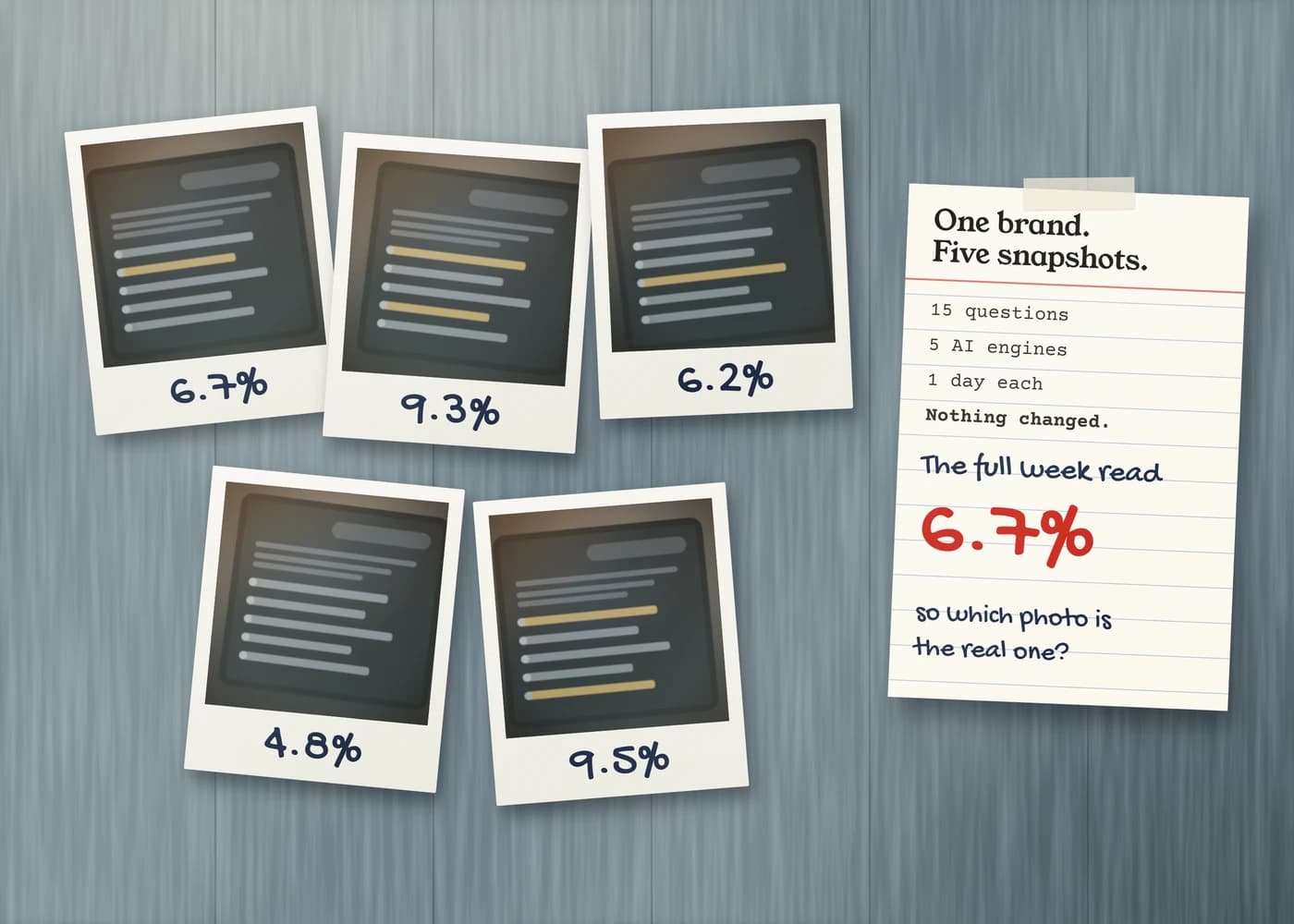
An AI visibility audit needs to be big enough to give you a number you can plan against, and 15 questions is not. Five small audits of company A drawn one after another, with nothing changed between them, read 6.7, 9.3, 6.2, 4.8 and 9.5 percent. The full week read 6.7. Across all 20,000 draws, the middle 90 percent of A's small audits ran from 1.5 to 12.3 percent, and fewer than half landed within 2 points of the true figure. 1
A full audit closes that gap. Asking all 90 questions once on the same five engines put each company's figure within about a point of the full week, in 9 draws out of 10. That is the difference between knowing you are somewhere between 2 and 12 percent and knowing you are at 6 or 7, and it is what makes a full audit usable as a baseline.
| Company | Full week | Small audit: 15 questions, one day | Full audit: 90 questions, one day |
|---|---|---|---|
| A | 6.7% | 1.5% to 12.3% | 5.6% to 7.6% |
| B | 1.6% | 0% to 4.1% | 1.1% to 2.0% |
| C | 5.7% | 1.3% to 11.0% | 4.7% to 6.9% |
These full-week figures count Google once, as the audits do, which is why they differ slightly from the seven-surface shares in the first table. A small audit, free or not, answers whether you have a problem. A full audit is the one to plan a quarter against.
Can two audits show whether the work is working?
Two audits can show whether the work is working only if both are full size. We took the same questions on two different days, with nothing changed in between, and compared the readings. For A and C, the two most visible companies, two small audits differed by 2 points or more in 40 to 44 percent of draws. Two full audits did so in 6 to 7 percent. A small audit before and after a quarter of work can show a gain that is nothing but noise.
| Company | Small audit: gap of 2 points or more | Small audit: 9 in 10 gaps under | Full audit: gap of 2 points or more | Full audit: 9 in 10 gaps under |
|---|---|---|---|---|
| A | 43.6% | 4.1 points | 6.3% | 1.8 points |
| B | 11.9% | 2.7 points | 0% | 0.9 points |
| C | 39.9% | 4.0 points | 7.0% | 1.8 points |
SparkToro and Gumshoe's study of brand recommendations found the same list of brands came back less than once in 100 runs, and its authors left open how many runs reliable visibility data needs. 3 On our three companies, 75 answers was too few to measure a change of a couple of points, and about 450 was enough.
Why does a single audit miss half of where you appear?
A single audit misses about half of where a brand appears because those places keep changing, even when the overall number does not. Across the three companies there were 153 pairs of a question and a surface where the brand showed up at least once in the week: 59 for A, 19 for B and 75 for C. In 131 of them, 86 percent, it showed up on some days and not others, and 59 showed it on one day only. Any single day caught between 47 and 52 percent of each company's pairs, as a median. 1
Meanwhile each company's overall daily share stayed within about 1.6 points across the week. A stable headline sits on top of a map that is constantly redrawn, which is why one audit of any size gives you an accurate number and only about half the map.
| Surface | Answers | Appearances | Share of answers | Spots with an appearance | Days present, in those spots |
|---|---|---|---|---|---|
| ChatGPT | 1,350 | 153 | 11.3% | 50 | 63% |
| Microsoft Copilot | 1,350 | 53 | 3.9% | 18 | 60% |
| Perplexity | 1,260 | 52 | 4.1% | 30 | 40% |
| Google AI Overviews | 1,318 | 38 | 2.9% | 21 | 43% |
| Gemini | 1,350 | 36 | 2.7% | 19 | 45% |
| Google AI Mode | 1,349 | 24 | 1.8% | 14 | 39% |
| Claude | 1,350 | 1 | 0.1% | 1 | 25% |
Two things in the surface table stand out. ChatGPT brought up these companies in 153 of 1,350 answers and Claude in 1, on the same questions. And the assistants rarely agree: of the 71 questions where a company appeared at all, 34 showed it on one surface only. An audit that checks one assistant is measuring that assistant, not AI.
The sources move faster still. Between 54 and 59 percent of the websites each company's answers cited turned up on one day of the week only, while 15 to 20 of the 20 most-cited stayed in any day's top 20. Allsopp found the same at page level: only about a quarter of the pages ChatGPT cited for a question were cited again the next day, and about half on AI Overviews. 2 The few sources that matter hold still, and the change happens in the long tail.
What does an audit that only counts mentions miss?
An audit that only counts mentions can miss almost all of a brand's appearances. Company A appeared in 152 answers, and its name was in the text of only 7. In the other 145 the assistant cited A's website as a source and never said who A was. An audit that counts mentions would have scored A close to zero, when its pages were feeding one answer in twenty. 1
The other two companies show how much this varies. B was named in 22 of its 49 appearances, and C in 91 of its 156. Being cited without being named is a different problem from not being found at all: the assistants already trust your pages and are not crediting you. Ask any audit, free or paid, whether it counts citations or only names, because the answer can flip the diagnosis.
When do you need a retainer?
You need a retainer when an audit shows a gap you cannot close yourself, and you need proof that the work closed it. Tracking alone does not justify one, because a tool can repeat the questions. What a retainer pays for is the work on pages other people publish, plus measurement repeated often enough to see through the noise above.
- The audit shows you absent or barely named, and the pages the assistants cite belong to other people: roundups, reviews and community threads. Software cannot place you on those, as we set out in AI visibility software or an agency.
- You appear on some days and not others. In the Audit Size Test that was 86 percent of the places a brand appeared at all. Those questions are the closest to being won, and the easiest to lose again.
- Somebody will ask whether the spend worked. That needs a fixed set of about 90 to 100 questions asked across the assistants every time, not 15, or the before and after readings fall inside each other's noise.
A retainer is the wrong purchase in three cases. If an audit shows you named in most answers and leading the list, watching for slippage costs far less. If nobody asks an AI assistant about your category yet, no amount of work will show up. And if nobody inside the company will own the work, a retainer becomes a monthly report that nobody reads.
| Where you are | What to buy |
|---|---|
| You do not know whether AI assistants name you | A small audit. A free one is enough |
| A small audit shows you named in most answers and leading | Nothing more yet. Repeat it each quarter |
| No assistant has much to say about your category | Nothing yet. Check again in a quarter |
| You need a number to plan against, or to judge a vendor's results by | A full audit of 90 to 100 questions |
| The gap is on your own website | A full audit, then fix your own pages |
| The gap is on pages other people publish | A retainer |
| You appear on some days and some assistants only | A retainer, measured on the same full set each month |
What should you ask before paying for an audit or a retainer?
Six questions sort a measurement you can trust from one you cannot. Each one comes from a result above.
- 01How many questions, on how many assistants? Fifteen shows where you stand. About 90 to 100 is what it takes to measure change.
- 02Do you count citations of our website, or only our name? For company A that was the difference between 7 appearances and 152.
- 03Is it the same question set every time? A different set each month makes every change unreadable.
- 04How many runs sit behind each number? One run of a full set gave a figure within about a point. Two small runs disagreed by 2 points or more in up to 44 percent of draws.
- 05Do we get the raw answers and the cited pages? Without them the score cannot be checked.
- 06What range comes with the number? A figure with no range looks more precise than any single audit is.
What did the test not cover?
- No company in the test was strong. The most visible appeared in about 6 to 7 percent of answers, so this says nothing about how a small audit behaves for a category leader appearing in 40 percent.
- It covers one week, three companies and two categories. Churn over a quarter could be larger.
- The audit-sized samples were drawn from tool-collected answers. A person typing the questions, or an audit that runs each question more than one way, could read differently.
Common questions
Receipts
03 sources- 01The Audit Size Test: two sizes of audit against a week of daily trackingRun in October 2026. Three B2B software companies (names withheld), 90 unbranded questions each, asked once a day for at least seven days (7, 8 and 7) on seven AI surfaces: ChatGPT, Claude, Perplexity, Microsoft Copilot, Gemini, Google AI Mode and Google AI Overviews. 9,327 answers on complete days; days with under 90 percent of a normal day's answers left out. An appearance is an answer that names the company in its own words or cites its website. Small audit: 15 questions, five engines with Google counted once, one day. Full audit: all 90 questions on the same five engines, one day. 20,000 seeded draws per company for each, compared with the same five-engine measure over all questions and complete days; leader and source tests used 5,000 draws. Source of every figure on this page not credited to another study. The link opens the data page, with every figure in tables.Last checked 16 October 2026
- 02Detailed, How volatile are AI responses?Glen Allsopp. More than 70,000 answers to 1,300+ commercial prompts, checked once a day for 28 days in ChatGPT and Google AI Overviews, US, logged out. Source of the leading brand appearing on 82 percent of days in ChatGPT and 89 percent in AI Overviews, and of about a quarter of the pages ChatGPT cited for a prompt being cited again the next day, against about half on AI Overviews.Last checked 16 October 2026
- 03Search Engine Journal, report of the SparkToro and Gumshoe studyRand Fishkin of SparkToro with Patrick O'Donnell of Gumshoe ran 2,961 prompts across ChatGPT, Claude and Google's AI. Source of the same brand list returning less than 1 percent of the time, and of the authors leaving open how many prompt runs reliable visibility data needs.Last checked 16 October 2026