How does Salienz work, in short?
Salienz builds a fixed set of 100 or 200 questions that buyers in a client's category put to AI engines, picks the 40 or 60 most worth winning, and builds the pages and third-party mentions that get the client named in those answers. The whole set is re-run across five engines every month, so progress is counted question by question instead of claimed.
- 01Interview the client for the questions its customers already ask, and collect any data it holds on them.
- 02Research the rest of the demand in search data, Reddit, social platforms, review sites, competitors' pages and the engines' own answers.
- 03Write the set as 90 questions without the client's name and 10 with it, each carrying the evidence for why it is there.
- 04Agree the questions and the competitor set with the client before anything runs.
- 05Group the questions into clusters by buyer stage and by the answer each one needs.
- 06Score every question and shortlist the 40, or the 60 on the 200-question plan, that the work sets out to win.
- 07Build topical authority around the shortlist, re-run the full set monthly, and report what moved.
The sections below take each step in turn. Where there is a number, it comes from one of two baselines we ran in September 2026: Sequence, a quote-to-cash billing platform, published in full, and one for a contract lifecycle management platform we haven't named.
What happens when a client first comes to Salienz?
The first conversation is an interview, and most of it circles one question: what do your customers ask before they buy? Founders, sales teams and customer success managers hear the same questions every week. Nothing makes a better starting point, because nobody had to guess at them. A buyer said them out loud.
We ask for them directly and in the buyer's own words, including the uncomfortable ones about price, migration and what the product does not do. If the company keeps any record of those questions, we use that too. It might be sales call notes, support tickets or a list of objections the team already tracks. Where there is no data, the interview carries more of the weight and the outside research carries the rest.
The same call settles the competitor set, meaning the rival brands every answer will be checked against. The company knows who it loses deals to, so it names them. We agree up to 15 before anything runs, and the list stays fixed from then on. A fixed list is what lets month three be compared with day one. A list chosen after the results come in can be made to show almost any gap.
Where do the rest of the questions come from?
Outside research, because an interview only hears from buyers who reached the company. A buyer who has not found it yet never talks to its sales team. Their questions turn up elsewhere: in search data, in forum threads, in reviews of rival products and in the answers the engines already give.
| Source | Tells us about | What it adds to the set |
|---|---|---|
| Client interview and client data | Known buyers | Questions buyers already ask, in their own words, and the objections that stall deals |
| DataForSEO | Search demand | The questions people type into Google and how often they type them |
| Google autocomplete | Search demand | How people begin a query, expanded with question and buying modifiers |
| Reddit and forums | Open questions | Questions asked in threads that no published page answers well |
| Social platforms | Public debate | What people in the category argue and complain about in public |
| Web search | Competition | Rivals' comparison and alternatives pages, and the listicles that rank for the category |
| Review sites such as G2 | Switching | What customers switched from, what they praise and what they say is missing |
| The engines themselves | Current answers | Live answers in clean sessions, and the sources each answer cites |
Each source catches something the others miss. Sequence's reviews on G2 kept naming Stripe Billing as the system customers had left, so the question of what a B2B SaaS company should move to when it outgrows Stripe Billing went into its set.
Research into the category also turned up that Stripe had completed its purchase of Metronome and Adyen its purchase of Orb. Buyers had compared both with Sequence, and their customers now had a reason to look again, so questions about leaving them went in as well. 1
Why are 90 of the 100 questions unbranded?
Because a question that already carries the company's name comes from a buyer who has already found the company. Winning that answer matters, but it is not new ground. The buyers a company is missing ask the other kind of question, about how to solve a problem and which products to look at. So the default set is 90 of those and 10 branded.
Sequence shows what a branded set would hide. In its first week of tracking it averaged 83.7 out of 100 on the ten questions that named it, and was usually the first brand in the answer. On the ninety that did not, it averaged 0.9, and on 62 of them it never appeared at all. 1
A report built on those ten questions would have shown a company winning, and every number in it would have been true. It would still have missed the problem. The 78 questions about solving a billing problem and the 12 about which platform to buy are where shortlists get made, and Sequence was close to absent from all of them. That is why branded wins do not count as progress in our reports. In Sequence's case they were there before any work started.
Which branded questions make the cut?
The ten branded questions are the ones a buyer asks late, once the company is on the shortlist and the deal can still be lost. They cover price, fit, implementation time, security, what customers say, what the product does not do, and comparisons with named rivals. A wrong answer to any of them can cost a deal the company had nearly won. Four of Sequence's ten, verbatim:
- How much does the Sequence billing platform cost and what is included?
- Sequence billing platform vs Chargebee for usage-based B2B SaaS
- What security certifications and data residency options does the Sequence billing platform have?
- What does the Sequence billing platform not do?
The name is never bare. G2 lists two separate products called Sequence, and the word also returns answers about genetics and mathematics. A prompt that says only "Sequence" gets answers about the wrong thing and reads as a false zero, so every branded question carries a qualifier such as "Sequence billing platform". Any company with a common word for a name needs the same care.
Branded questions are tracked for defence. A falling score is an early sign that a rival's comparison page or an outdated review has started shaping the answer, and rivals do write those pages. In the contract lifecycle platform's first six days, engines cited four vendors' pages about leaving it 323 times. 2
How is the question set checked with the company?
Every question carries its evidence, and the company signs off on the whole set before anything runs. The evidence records where a question came from and why a buyer would ask it: an interview answer, search data, a thread, a review or a live engine answer. A question with nothing behind it stays out, however plausible it sounds.
The company then checks what we cannot check alone. Do its buyers really ask this? Does the product actually answer it? Are these the rivals it loses to? The second check matters most. A question the product cannot honestly answer would create demand that never converts, so it either comes out or stays in as a warning row, which we track but do not target.
In the Foundation audit this happens on day one. The query list and the competitor set are agreed on the kickoff call, written up and sent the same day, and the run starts after that. 3
How do the questions become clusters?
The questions are grouped twice, once by where the buyer is and once by the answer each question needs. The first grouping uses four buyer stages, from working out how to solve a problem through to checking whether one product is right. The second decides how many pages the work needs, because one well-built page can win several questions that share an answer.
| Stage | Questions | Names the client | What the buyer is asking |
|---|---|---|---|
| Discovery | 78 | No | How do I solve this problem? |
| Shortlist | 12 | No | Which platforms should I look at? |
| Comparison | 3 | Yes | This product, or the other one? |
| Due diligence | 7 | Yes | Is this product right for us? |
The answer test is simple. Two questions that would get the same answer belong on one page. Two that would lead a reader to different recommendations get separate pages, however alike they sound. When we planned this blog, questions about reporting AI visibility to a board, proving its return and explaining a flat month resolved to one answer, so they became one page. Questions about whether review sites matter and whether Reddit matters look alike, but the advice differs, so they became two.
Each cluster gets a hub for its broadest question, with the narrower pages linking up to it. The hub is the broadest page in the cluster rather than an extra page, so it never competes with its own spokes for the same question.
How do we choose the 40 questions to win?
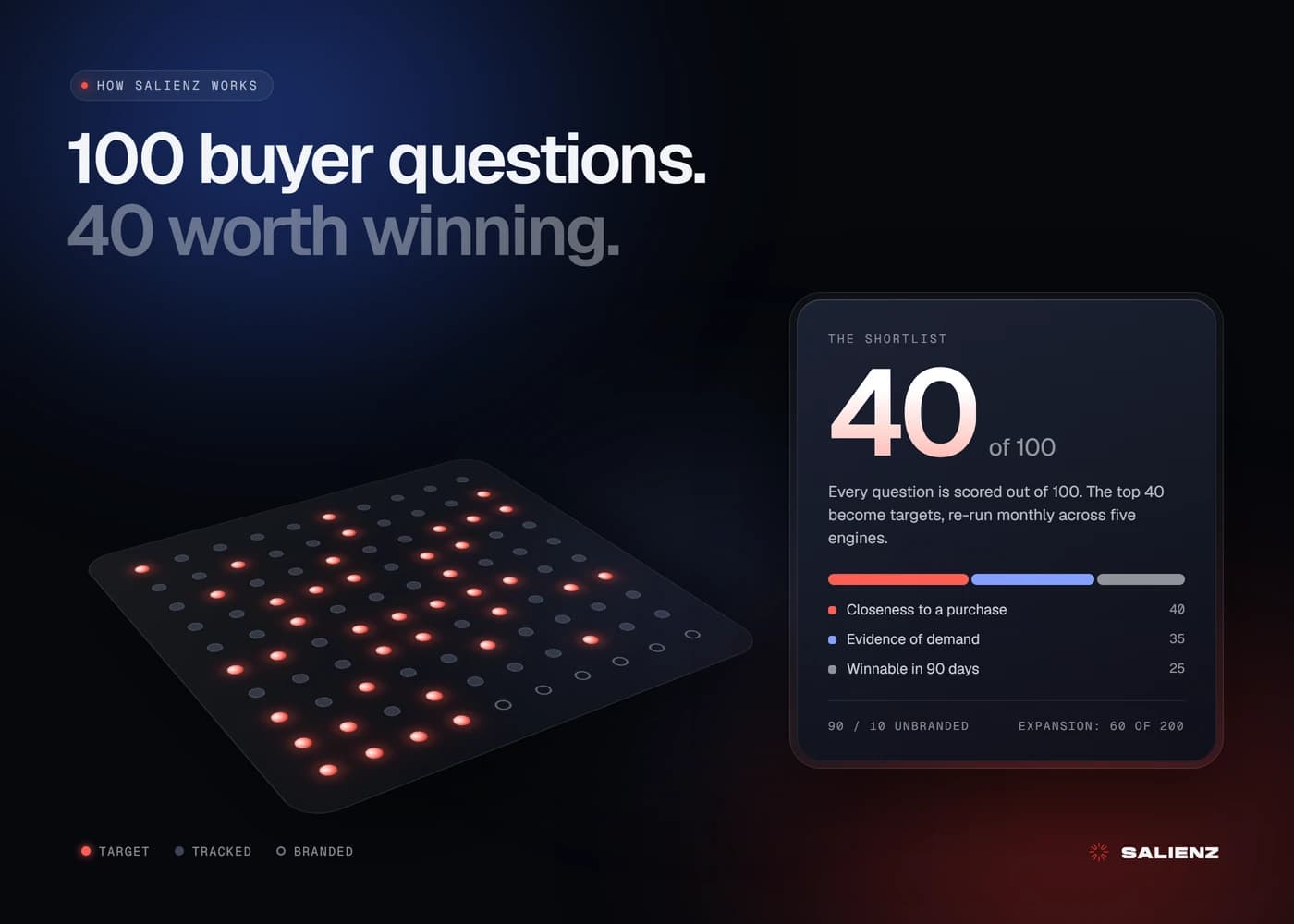
Every question in the set gets a score out of 100, and the top 40 become the targets. On the 200-question plan, the top 60 do. The score has three parts, and the heaviest is how close the buyer is to spending money.
| Part of the score | Points | What it asks |
|---|---|---|
| Closeness to a purchase | 40 | Is the buyer choosing a product, or still learning about the problem? |
| Evidence of demand | 35 | How much proof is there that buyers ask this, from the interview, search data, threads and reviews? |
| Winnable in 90 days | 25 | Can the client credibly be named in this answer within the term, given who holds it now? |
Ties go to buying questions first, then comparison questions, then learning questions, and after that to how much competing content already exists. We treat the scores as bands rather than precise figures. A question at 93 and one at 92 are equally urgent, so the bands carry the meaning: 85 and above, 70 to 84, 55 to 69, and below 55. Order inside a band is a judgement call.
Two checks run before the list is final. The first compares every pair of questions for overlap, because a set written in batches drifts, and two near-duplicates spend two targets on one answer. The second marks questions that touch a known weakness in the product. Those stay tracked, so a bad answer shows up in a report before it shows up in a lost deal, but they are not targets.
One tag matters for measurement. A few questions get answered with advice and sources rather than a list of vendors, such as a benchmark, a checklist or a definition. On those we score whether the client's site is cited, not whether its name appears. Scored on the name, they would read as a permanent zero while the work was succeeding.
Which AI engines does Salienz track?
Five engines: ChatGPT, Claude, Perplexity, Microsoft Copilot and Google. Google counts once as a company but answers through three separate surfaces, AI Overviews, AI Mode and Gemini, and we measure each on its own. So a report shows seven columns where the pricing page says five engines.
| Engine | Surfaces | Measured as |
|---|---|---|
| ChatGPT | 1 | ChatGPT |
| Claude | 1 | Claude |
| Perplexity | 1 | Perplexity |
| Microsoft Copilot | 1 | Microsoft Copilot |
| 3 | AI Overviews, AI Mode and Gemini, each scored separately |
The three Google surfaces do not agree with each other, which is why they are split. In Sequence's first week, on the same questions, Stripe scored 19.1 out of 100 in AI Overviews, 23.3 in AI Mode and 30.0 in Gemini. 1 Claude differs most of all. The contract lifecycle platform led the eleven brands in its set across all seven surfaces, yet Claude gave its closest rival 50.5 against its 37.9. 2
What does Salienz build to win the 40?
Topical authority around the shortlist. The aim is for the client to answer every question in a target cluster, on its own site and in the places engines already read, so that it becomes an obvious source for the whole cluster instead of one page for one keyword. That takes pages the client owns and mentions on pages it does not.
On the client's site the work is cite-ready assets written against questions the baseline showed it losing: comparison pages, alternatives pages, answer pages and blog posts built to be quoted. Pages that already rank but are never quoted get rewritten. Each one opens with a direct answer, dates its facts and names its sources, so an engine can lift a passage whole. The content work has its own page.
Off the site, the work goes to the listicles, roundups and threads the engines draw on, and the baseline says which ones. For the contract lifecycle platform it listed pages the engines cited that named its rivals and left it out. The most cited, a 2026 roundup of contract lifecycle software on summize.com, was cited 126 times in six days. 2 Getting a client onto pages like that is placement work, done alongside guest posts, digital PR and Reddit participation under real names.
| Work | Domination, 100 questions | Expansion, 200 questions |
|---|---|---|
| Target questions | 40 | 60 |
| Cite-ready assets | 10 a month, 30 in all | 15 a month, 45 in all |
| Existing page rewrites | Up to 4 a month | Up to 8 a month |
| Listicle and roundup placements | Up to 15 across the term | Up to 25 across the term |
| Guest posts and digital PR | 2 a month | 4 a month |
| 4 posts and 45 to 60 comments a month | 6 posts and 75 to 90 comments a month | |
| Internal links added | Up to 90 a quarter | Up to 180 a quarter |
| Technical fix cycles | 2 a quarter | 2 a quarter |
| Original research | Not included | 1 a quarter |
| Fee | $3,499 a month | $5,499 a month |
Technical work sits under all of it, because an engine cannot quote a page it cannot crawl or render. It runs on a fixed cycle rather than being sold as the strategy. Entity work runs alongside it: finding what the engines get wrong about the company, then correcting it at the source they took it from.
How does Salienz measure progress?
By re-running the same question set on every engine each month and counting the questions where an engine now names the client and did not at baseline. The set is fixed once agreed, so month three is measured on the same instrument as day one and the two numbers can be compared.
Domination sets out 30 to 40 questions won by day 90, against its 40 targets. Expansion sets out 45 to 60, against 60. Neither is a guarantee. The engines re-rank without notice and nobody outside the labs controls what they say. What we guarantee is the work in the scope, a measured baseline and a monthly report that shows a flat month as flat. 4 5
The report also lists every placement with its live URL, the sources each engine cited, how the named rivals moved on the same questions, and AI-sourced sessions followed through to demos and signups.
How is this different from most AI visibility agencies?
Mostly in what gets measured, since the measurement decides where the work is aimed. A common audit runs five or six prompts in one engine and screenshots the answers. The competitor set is picked after the run, which is how a gap gets to look large, and the next run is free to prove whatever needs proving.
| What to compare | Salienz | Typical engagement |
|---|---|---|
| Questions tracked | 100 or 200, on five engines and seven surfaces | Five or six, often in ChatGPT alone |
| Where the questions come from | Interview, client data and outside research, with evidence for each | A template for the category |
| Competitor set | Up to 15, agreed before anything runs | Chosen after the run |
| Repeat runs | The same fixed set every month | Ad hoc |
| Headline advice | Third-party sources and pages built to be quoted | llms.txt, schema for AI, content chunking |
| Content | Each page mapped to a question the client was losing | Volume |
One question sorts agencies quickly, and it applies to us too: what share of the tracked questions contain your name? A set heavy with branded questions reports good numbers from the first month, because engines already answer those well. Sequence's ten branded questions averaged 83.7 before any work began. 1
Two more differences are structural. We take one client per product sub-niche, so the questions we are trying to win for you are not ones we are also trying to win for a competitor. The agencies that publish the same rule are compared in a separate post.
The baselines are also published with their method, so anyone can check how the numbers were taken. If an agency already runs this work for you, four written requests will show whether it is aimed at the right questions.
Common questions
Receipts
05 sources- 01Salienz, Sequence in AI searchFirst-week baseline, 18 to 24 September 2026: 100 questions across seven engines against 15 fixed rivals, 4,337 answers read. Source of the stage counts, the branded and unbranded averages, the per-engine scores and the two acquisitions.Last checked 25 September 2026
- 02Salienz, contract lifecycle platform baseline (unpublished)Six-day baseline, 19 to 24 September 2026: 124 questions across seven engines against 10 fixed rivals. Source of the Claude scores, the pages about leaving the platform and the cited lists that leave it out. The company isn't named because it hasn't agreed to be featured.Last checked 25 September 2026
- 03Salienz Foundation auditThe $800 audit: 100 prompts across five engines, with the query list and competitor set agreed on the kickoff call before the run starts.Last checked 25 September 2026
- 04Salienz Domination retainer$3,499 a month over a 90-day term: 100 questions with the top 40 prioritised, the deliverables in the build table, and 30 to 40 questions won as the day-90 outcome.Last checked 25 September 2026
- 05Salienz Expansion retainer$5,499 a month over a 90-day term: 200 questions with the top 60 prioritised, the deliverables in the build table, and 45 to 60 questions won as the day-90 outcome.Last checked 25 September 2026