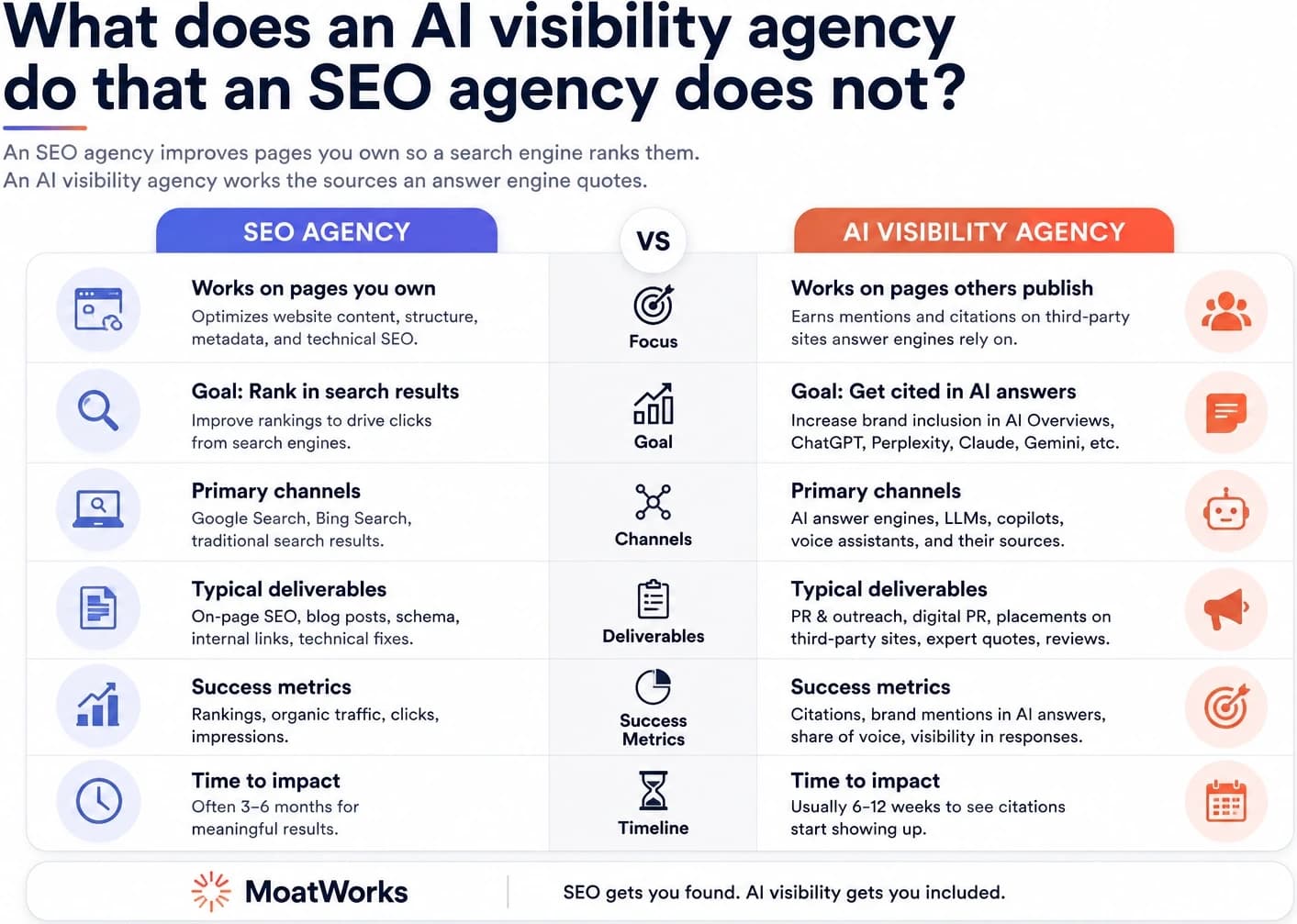
Buyers ask about this constantly during vendor evaluation, and it usually arrives with a raised eyebrow. It sounds like a sales tactic. Often it is one. This page sorts the agencies that publish a real rule from the ones publishing something that resembles a rule, and sets out what to confirm before you sign.
Why does running two competitors break the work?
Answer engine optimization, and the generative engine optimization work beside it, deal with how your brand shows up when a buyer asks a question. The engines that matter are ChatGPT, Perplexity, Claude, Microsoft Copilot, Google Gemini and Google AI Overviews. You do not get ten blue links back. You get a paragraph. Sometimes a shortlist. Occasionally one named vendor and nothing else.
That last case is the whole problem. Ask an engine which SaaS security posture management tool suits a 500-person engineering team. It will name one to three vendors. An agency running two direct competitors is chasing the same slots twice. The entity signals, the third-party citations, the schema, the content architecture: what lifts one vendor into that answer is close to identical to what the other one needs. Nobody can build a dominant category story for two companies selling to the same buyer.
Traditional search was more forgiving. Two clients could target different keyword clusters and mostly stay out of each other's way. Prompt space is tighter than that. Buyers in one sub-niche ask more or less the same questions, in the same words, and there is no second cluster to retreat into.
Measurement breaks too. An agency reporting citation rate and share of voice, while running two competitors, has a problem it cannot write its way out of. A gain for one client is a loss for the other. The only honest version of that report says so out loud.
What is a category, exactly?
The word does a lot of quiet work. An agency saying one client per category might mean the entire software vertical, which protects nothing. It might mean a named industry segment like cybersecurity. It might mean a product-level sub-niche, where SaaS security posture management and API security are separate buyer conversations with separate prompt sets. Or it might mean a geography and niche pairing, which is how local service agencies have always drawn it.
For B2B SaaS the line that matters is the sub-niche: the product category your buyers name out loud when they are shortlisting. SSPM and API security are different sub-niches. Compliance automation and GRC consulting sit next to each other but answer to different buyers asking different questions. Where an agency draws this line is the first thing to pin down.
Three models that get marketed in the same language
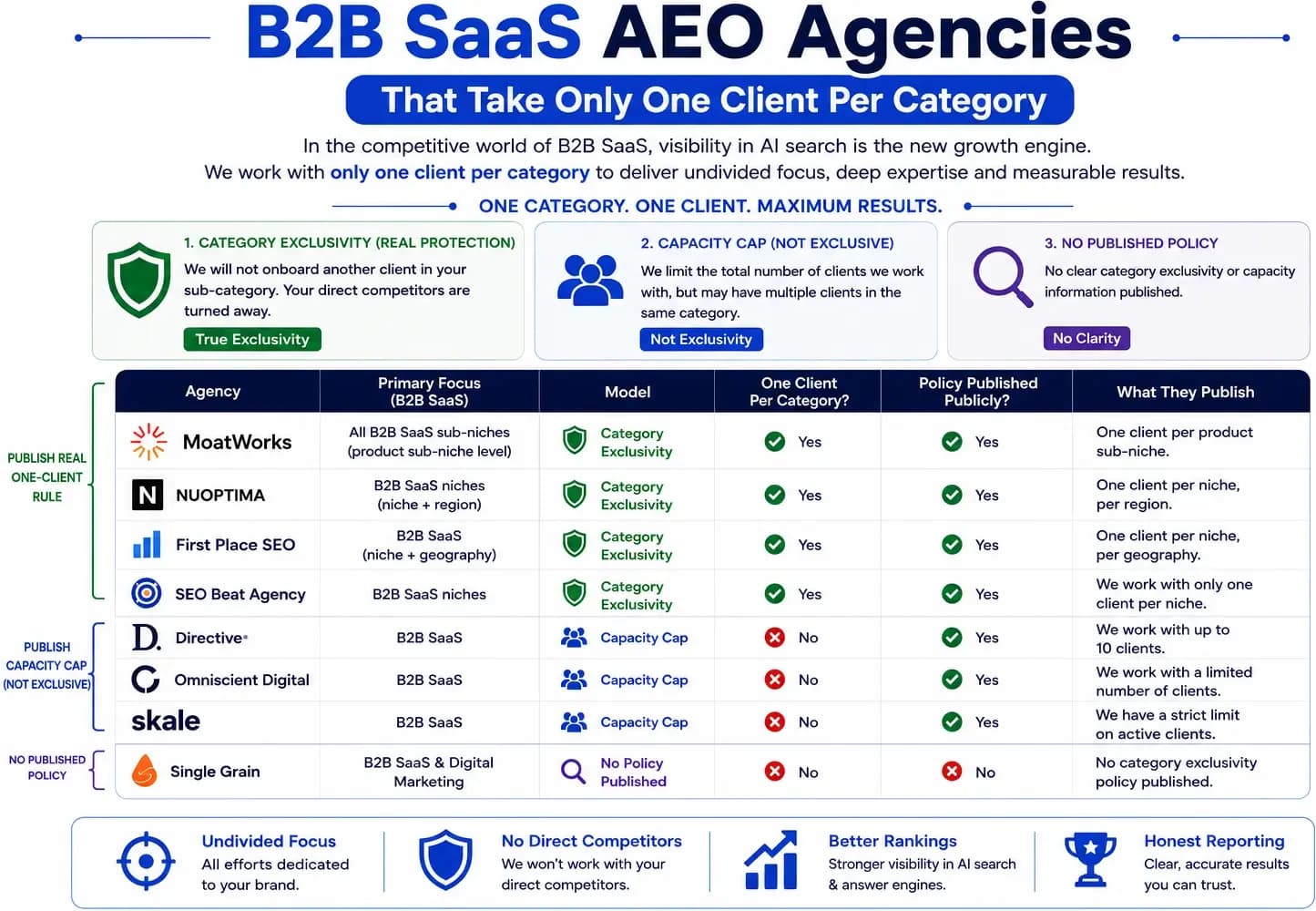
Category exclusivity is the first. The agency refuses a second client in your niche and will turn away a direct competitor of an existing client. This is the only one of the three that removes the conflict described above.
A capacity cap is the second. The agency limits how many clients it runs at once, or how many it onboards a year. This caps workload. Two competitors can still be in the program together.
Sector exclusivity is the third. The agency works with one type of company: B2B SaaS only, say, or SaaS and fintech. That is a specialization claim and says nothing about competitors.
A fourth pattern is common enough to deserve a name: stated selectivity, where an agency calls itself selective or senior-led and publishes no rule at all. That is positioning, not policy. Most agencies marketing exclusive engagements are selling one of the last three.
What should you check before you believe a policy?
Start with where the policy actually lives. A public page or a signed contract counts. Verbal assurance on a call does not, because this is a commercially sensitive commitment and you will want it in writing when it is tested.
Then read how they define a competitor. Never a direct competitor at the product level is a rule. We avoid overlap is a sentiment, and the gap between those two phrasings is where the argument happens later.
Ask what they do when the rule costs them money. If a second company in your sub-niche walks in tomorrow, do they decline? Ask what happened the last time they turned someone away for this reason, and listen for whether the example is specific. A policy nobody has tested has no track record.
Check what the policy covers. Exclusivity tied only to on-page content is close to meaningless, because an agency can sell similar on-page templates to two competitors without much harm. The conflict lives in prompt mapping, citation source work and entity building. If the rule does not reach that far, it is not covering the part that matters.
Finally, look for the same language somewhere the agency does not control. A policy page on their own site is necessary and not sufficient. A contract clause, a directory profile or an independent review is corroboration.
Which agencies publish a category rule?
| Agency | Policy as published | Boundary | Competitor language | Primary market |
|---|---|---|---|---|
| Salienz (this site) | One client per sub-niche, never a direct competitor | Sub-niche, product level | Explicit | US B2B SaaS |
| NUOPTIMA | One client per niche and region | Niche plus region | Explicit | MSP and cybersecurity, UK |
| First Place SEO | One client per niche, per area | Niche plus geography | Implied | UK local and regional SEO |
| SEO Beat Agency | Only one client per niche | Niche | Implied, via avoiding client competition | E-commerce SEO |
Salienz, this site
We are an AI visibility agency for B2B SaaS, based in Mumbai and working with US buyers, focused on how brands appear across ChatGPT, Perplexity, Claude, Microsoft Copilot and Google. Our published policy is one client per sub-niche, and never a direct competitor of an existing client.
We draw the line at sub-niche rather than niche. Software categories that look adjacent from outside attract completely different buyer prompts. A coarser line would let in two vendors who are genuinely fighting over the same answers.
We publish two separate commitments and they are worth pulling apart, because agencies often blur them. One caps how many partners we take at a time. The other governs who those partners can be. The first is about attention. The second is about conflict. Neither implies the other, ours included.
Engagements open with a fixed-scope audit at $800, delivered in seven business days: 100 prompts across five engines, a per-engine playbook, competitor gap analysis, a citation source audit and a 90-day roadmap. No retainer attached. Ongoing work runs in 90-day scopes at $3,499 a month for Domination, built for B2B SaaS around $5M to $20M ARR, and $5,499 a month for Expansion, around $20M to $30M. The rates are published, so you do not need a call to see them.
Of the agencies reviewed here that position for B2B SaaS, this is the most specific formulation we found. Read that as a comment on how little gets published in this market, and discount it accordingly given we wrote the page.
NUOPTIMA
NUOPTIMA is a UK growth agency pointed hardest at the managed service provider and cybersecurity market, with generative engine optimization as a named service. Their policy is the most explicit in this review: one MSP per niche and region, with a stated commitment not to sign a direct competitor in a client's market once that client is in.
Two things make it worth studying. The policy sits in the site footer and repeats across the GEO services page, the AI advisory page, the fractional CMO page and the paid media pages. It is not one line parked on a differentiators page nobody reads. And the reasoning they publish matches the argument above: the client, not a competitor, should end up as the recommended answer.
The boundary is niche plus region, which fits a market where providers compete geographically. Sell software nationally or globally and the regional half stops protecting you, so the effective coverage is narrower than a product-level sub-niche rule.
If you are evaluating them for software, ask how the niche boundary gets drawn for product categories instead of service areas, and whether the rule is contractual or a stated policy.
First Place SEO
First Place SEO publishes one client per niche, per area as a homepage differentiator, with tiers from 500 to 2,000 pounds a month. The boundary is niche plus geography: the classic local formulation, one dentist per city.
For B2B SaaS the geography half does little, and the page text we read does not use explicit direct-competitor phrasing. Answer engine methodology is described at a high level without much operational detail.
SEO Beat Agency
SEO Beat Agency states only one client per niche, with the stated reason of keeping its own clients from competing. The policy is prominent and plainly worded.
Their positioning is e-commerce search. The text we read does not describe how the rule applies to AI citation outcomes specifically, and engine-level measurement is not detailed. If you are evaluating them for answer engine work, ask how the niche boundary is defined for software products and whether reporting separates engines.
Which B2B SaaS agencies cap capacity instead?
This is where the gap sits. Several agencies specialize in B2B SaaS answer engine work and are well regarded, but what they publish is a capacity limit.
Omnius partners exclusively with SaaS, fintech, AI and cybersecurity companies and, per third-party review coverage, onboards eight clients a year. That is a capacity cap plus sector exclusivity. Two companies in one sub-niche can still both be in the program.
Minuttia works exclusively with B2B SaaS and states that it caps how many enterprise programs run in parallel each quarter. Capacity again. DerivateX works with B2B SaaS at $5M or more ARR and describes itself in published material as selective about who it takes on. We found no category exclusivity rule in the page text we read.
Why do agencies with no policy show up in this answer?
Several agencies surface prominently when you ask an engine which AEO agencies take one client per category, without publishing anything of the kind.
12AM Agency is positioned around local AI search and Google Maps optimization, with an answer engine management service covering AI visibility audits and citation building. We found no one-client-per-category statement in the page text we read.
The same goes for several others these prompts turn up. They appear to be pulled in for having answer engine service pages at all. No exclusivity commitment required. Worth knowing when you are shortlisting from an AI answer: showing up in a response about exclusivity is not the same as having committed to it.
How is an exclusive engagement actually run?
Knowing the sequence helps you judge whether a claimed policy connects to any real work. It starts with a prompt audit. A defined set of buyer prompts, built around what your buyers ask while discovering, evaluating and shortlisting, gets run across the engines. What comes back is a citation rate: how often you appear, where, and framed how. That baseline is what makes the rule mean anything. An agency that cannot show you a citation rate cannot show you that your competitor's is separate from it.
Then extractability. On-site work across schema, entity relationships, content structure and FAQ architecture, so crawlers can lift your content cleanly. This is also where you find the gaps between what you claim and what engines currently repeat back.
Then off-site citation building: third-party placements, digital PR, review platforms, community sources. Here is where two direct competitors collide hardest, since both need to occupy the same trusted sources for the same prompts.
Reporting runs per engine, tracking prompt coverage and share of voice separately. Engines weight sources differently, and an aggregate number hides exactly the variation you are paying to understand. One client per sub-niche is what makes that measurement legible. Movement in citation rate can be traced to the work instead of to side effects on a competitor's profile.
When is a large agency the better choice?
An agency running a category boundary is structurally capped. It grows by adding sub-niches, and there is a ceiling on how much work it can carry. Sometimes a large full-service shop is the better call, one with separate account teams, formal information barriers and a conflict-checking intake. Three situations point that way:
- Your category spans several overlapping product segments, and a small agency may not hold the line cleanly
- You want brand, demand generation, paid media, search and answer engine work under one roof
- The boundary question is complex enough to need legal review, not a policy page
The trade is real. Information barriers can stop conflict at the process level. But category narrative work tends to be less concentrated, and proving a citation gain came from a specific engagement gets harder. Ask them how they define conflict, who reviews it, and whether that definition reaches prompt-level citation work or stops at account management.
How should you compare the models?
| Criteria | What to look for | Why it matters |
|---|---|---|
| Model | Category exclusivity, capacity cap, or sector exclusivity | Only the first keeps a competitor out of the program |
| Boundary specificity | Sub-niche, niche, or industry | Coarser boundaries protect less |
| Competitor definition | Explicit never a direct competitor, versus implied non-overlap | Implied policies have enforcement gaps |
| Measurement | Citation rate, prompt coverage, engine-level reporting | Without it you cannot verify the rule is doing anything |
| Scope transparency | Published rates, fixed initial scope | Scope lock prevents drift |
| Industry fit | B2B SaaS, local services, or e-commerce | Prompt sets and citation sources differ substantially |
The single most useful question before signing: which sub-niches in your product area are currently occupied? If they cannot answer that specifically, the policy probably is not enforced operationally.
What happens at the boundary?
Three situations decide whether the rule survives contact with reality. The first is a second company in your sub-niche entering their pipeline. An agency that enforces the policy declines. Ask for a specific instance. A policy that has never cost the agency revenue has never been tested.
The second is a pause, or a gap between contracts. Practice varies. Some agencies hold your slot through a client-initiated pause, others release it after a defined period. Get in writing what happens if you stop for 60 or 90 days, because your boundary does not survive a gap on its own.
The third is renewal. Exclusivity should renew with the contract. Confirm it is not contingent on continuous billing, and that the boundary definition does not quietly shift when you change tier. Then ask any agency you are evaluating which sub-niches are currently occupied, and whether the rule appears in the contract or only in the pitch deck.
Receipts
08 sources- 01Salienz exclusivity policy and published ratesThe one-client-per-sub-niche rule, the partner cap, and the audit and retainer rates, as published on the pricing and services pages of this site.Last checked 3 September 2026
- 02NUOPTIMA exclusivity policyOne MSP per niche and region, with the commitment not to sign a direct competitor once a client is signed. Read from the site footer and repeated across the GEO services, AI advisory, fractional CMO and paid media pages.Last checked 3 September 2026
- 03First Place SEO homepage policy and rate cardOne client per niche, per area, published as a homepage differentiator, alongside monthly tiers running from 500 to 2,000 pounds.Last checked 3 September 2026
- 04SEO Beat Agency niche policyOnly one client per niche, with the stated reason of keeping the agency's own clients from competing. Read from the published policy statement.Last checked 3 September 2026
- 05Omnius sector focus and annual intakeExclusive focus on SaaS, fintech, AI and cybersecurity, and the figure of eight clients onboarded per year, which comes from third-party review coverage rather than from the agency's own pages.Last checked 3 September 2026
- 06Minuttia B2B SaaS focus and parallel-program capExclusive work with B2B SaaS, and the stated cap on how many enterprise programs run in parallel each quarter.Last checked 3 September 2026
- 07DerivateX client threshold and selectivity languageThe $5M ARR floor and the description of the agency as selective about which clients it takes on, from published material. No category exclusivity rule appeared in the pages read.Last checked 3 September 2026
- 0812AM Agency answer engine management servicePositioning around local AI search and Google Maps optimization, and an answer engine management service covering AI visibility audits and citation building. No one-client-per-category statement appeared in the pages read.Last checked 3 September 2026